

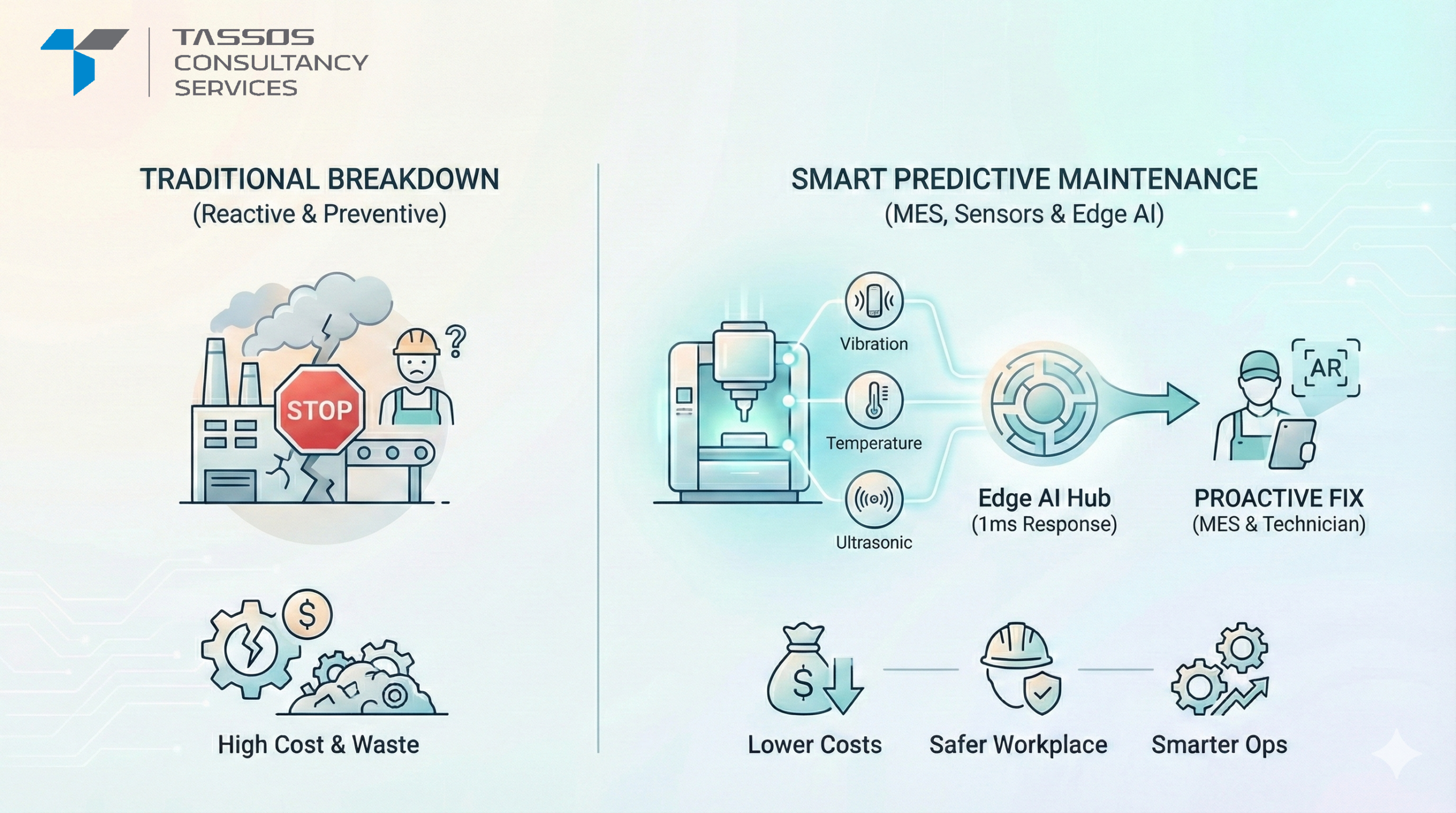
Smart factories don’t wait for machines to break. With Manufacturing Execution Systems (MES), sensors, and AI, they predict failures before production stops.
When Machines Break, Money Drains
When a production line stops unexpectedly, costs pile up fast—repair bills, lost time, missed orders, and unhappy customers. For years, manufacturers could only react by running machines until they break, then rushing to fix them. This approach wastes money and creates chaos on the factory floor.
Now there’s a better way. MES, smart sensors, and AI create Predictive Maintenance—a system that spots problems before they happen. Instead of dealing with emergencies, manufacturers can plan maintenance during scheduled downtime, keeping production running smoothly and profitably.
Two Old Ways That Waste Money
Traditional maintenance has two flawed approaches that continue to cost manufacturers millions:
- Reactive Maintenance: Fixing things after they break leads to expensive emergency repairs and lost production.
- Preventive Maintenance: Replacing parts on a fixed schedule wastes money on parts that still work perfectly.
The better solution is monitoring machines in real-time and fixing them only when needed, but before they fail. This approach maximizes equipment lifespan while minimizing downtime and maintenance costs.
How Sensors Watch Machine Health
Smart sensors are like a doctor’s tools for machines, constantly measuring critical health indicators:
- Vibration sensors catch worn bearings and mechanical imbalances before they cause damage, often detecting problems weeks before they’re noticeable.
- Temperature sensors spot overheating that signals electrical or friction problems, preventing fires and equipment destruction.
- Ultrasonic sensors detect hidden leaks and cracks that the human ear cannot hear, catching structural failures early.
These sensors collect massive amounts of data every hour, creating a continuous health record for every machine. But data alone isn’t useful—you need AI to analyze it, identify patterns, and predict when failures will occur.
Edge AI: Making Split-Second Decisions
Here’s the problem with old systems: sending sensor data to the cloud and back takes 10-50 milliseconds on standard networks. When a machine spins at 10,000 RPM, that delay can mean disaster. A bearing can fail or a motor can burn out in the time it takes to get a response from a distant server.
Edge Computing solves this by analyzing data right on the factory floor. Sensors collect data continuously, edge computers analyze it instantly using AI in under 10 milliseconds, and the MES/Cloud tracks long-term patterns and schedules maintenance. This three-tier system combines the speed of local processing with the intelligence of centralized pattern recognition.
Siemens Smart Factories demonstrate this in action, using 5G and edge AI to predict failures and adjust operations in real-time, eliminating unexpected downtime completely. Their system can detect an anomaly, diagnose the problem, and adjust production—all before a human operator even notices something is wrong.
From Warning to Fix: The Automated Response
When a sensor detects trouble, the system responds automatically without human intervention. The Edge AI flags the problem in milliseconds, identifying exactly what’s wrong. The MES receives this alert and creates a maintenance task automatically, assigning priority based on severity. The system keeps production running by shifting work to other machines, ensuring that one faulty motor doesn’t stop the entire factory. Finally, the technician gets an alert with the exact problem and needed parts, often delivered to their smartphone or smartwatch.
This eliminates the scrambling and guesswork that plague traditional maintenance. Instead of discovering a problem when a machine stops working, technicians know about it days or weeks in advance. They can order parts, schedule the repair during planned downtime, and fix the issue before it impacts production.
Why 5G Matters
Factories are adding billions of sensors as they embrace Industry 4.0, creating massive connectivity challenges. Wi-Fi is unreliable in industrial environments, and running cables to every sensor is expensive and inflexible. 5G delivers three critical capabilities:
- 1-millisecond response time enables instant decisions for fast-moving machinery, ensuring safety systems respond quickly enough to prevent accidents.
- 10 Gbps speeds handle AI video inspection systems that process high-resolution images in real-time.
- 1 million devices per square kilometer means every motor, valve, and actuator can be monitored simultaneously.
Plus, critical safety data gets its own dedicated network “lane” through network slicing, guaranteeing that emergency alerts never get delayed by less important traffic.
Three Big Benefits
Smarter Operations: AI predicts slowdowns and optimizes warehouse robots instantly, ensuring spare parts arrive exactly when needed. This extends beyond maintenance to transform the entire supply chain, creating a self-optimizing factory that continuously improves its own efficiency. Companies see reduced storage costs and eliminated shortages.
Safer Workplace: Dangerous problems are caught early, before they can hurt workers or damage equipment. A vibrating bearing that might cause a catastrophic failure gets fixed during a scheduled maintenance window instead of exploding during a shift change. This proactive approach has saved countless lives across manufacturing facilities worldwide.
Lower Costs: Replace parts only when sensors show they’re 95% worn, not every 3 months “just in case.” This cuts maintenance costs dramatically while actually improving reliability. Companies report maintenance cost reductions of 30-40% after implementing predictive maintenance. The parts that do get replaced are genuinely worn out, maximizing the return on every maintenance dollar spent.
The Future: Self-Managing Factories
The next step is Digital Twins—virtual copies of factory floors powered by real-time sensor data. Operators can test maintenance strategies virtually before trying them in real life, simulating different scenarios to find the optimal approach. These digital replicas learn from every breakdown, every successful repair, and every production run, becoming smarter over time.
The bottom line is simple: you can’t make real-time decisions if your system is hundreds of miles away in a cloud data center. By putting AI right next to machines through Edge Computing, manufacturers are transforming from reactive to proactive. They’re building factories that don’t just respond to problems—they prevent them. The convergence of MES, sensors, and Edge AI is creating manufacturing environments that are safer, more efficient, and more profitable than ever before.
***
Keywords :
predictive maintenance manufacturing, MES predictive maintenance, industrial IoT sensors, IoT smart factory, edge AI manufacturing, manufacturing execution system MES, smart factory technology, machine health monitoring, predictive maintenance systems, industrial edge computing, factory automation solutions, Industry 4.0 predictive maintenance, real time machine monitoring, industrial AI solutions, equipment failure prediction, condition based maintenance, sensor based maintenance, vibration monitoring sensors, temperature monitoring industrial, ultrasonic sensors manufacturing, industrial data analytics, manufacturing downtime reduction, factory maintenance automation, connected factory systems, industrial 5G networks, edge computing IoT, manufacturing digital transformation, industrial predictive analytics, machine learning manufacturing maintenance, industrial automation software, factory operational intelligence, real time production monitoring, manufacturing asset management, smart manufacturing systems, predictive maintenance software, industrial equipment monitoring, automated maintenance scheduling, manufacturing performance optimization, digital twin manufacturing, self managing factories, intelligent factory systems, cyber physical systems manufacturing, industrial sensor networks, production line monitoring, smart manufacturing platforms, factory AI solutions, maintenance cost reduction manufacturing, industrial safety systems, manufacturing efficiency technology, next generation manufacturing technology, IoT platforms, manufacturing innovation technology, factory modernization solutions, connected manufacturing ecosystem.
0 Comments