

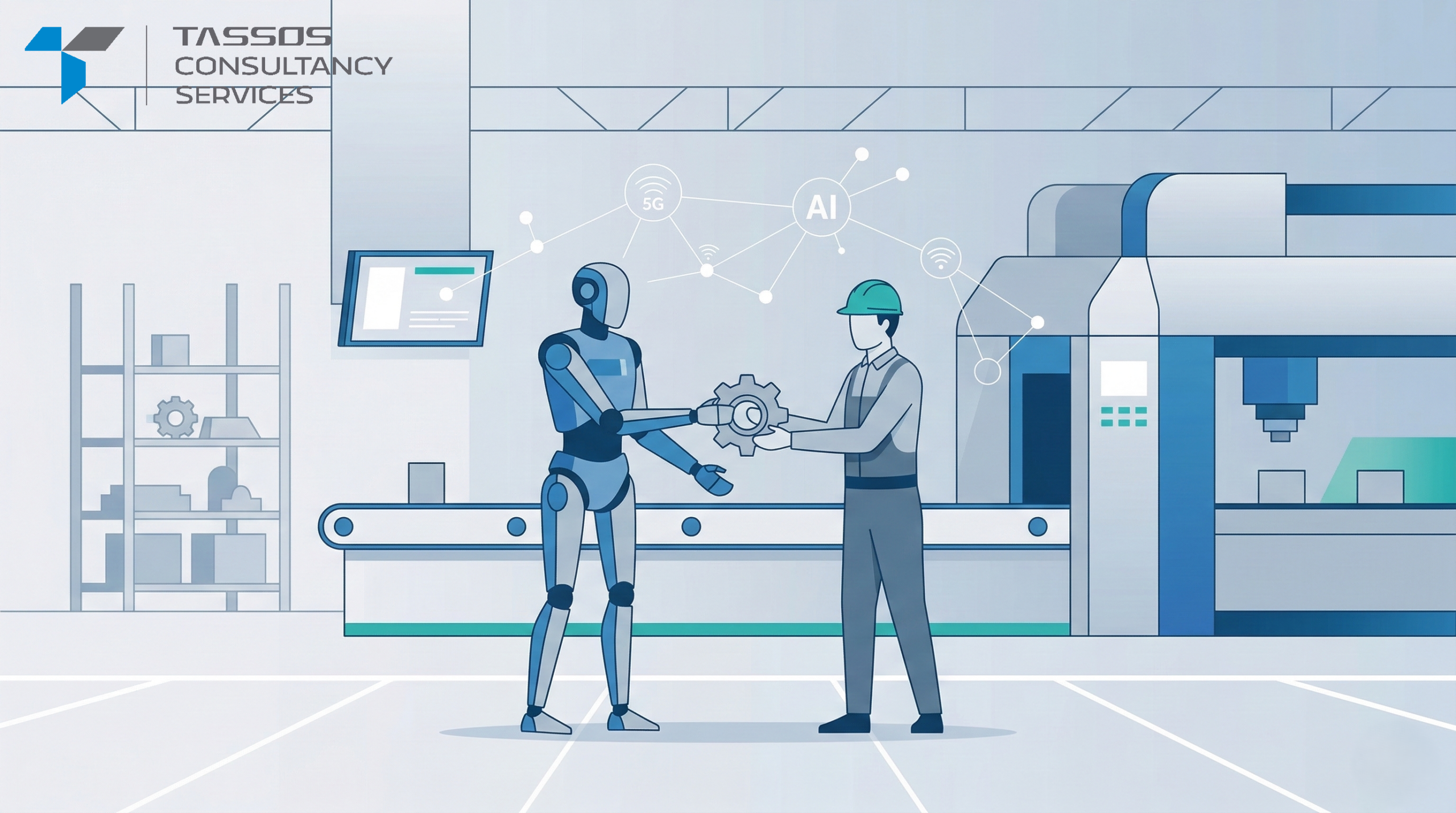
Humanoid Robots Are Entering Our Factories
Factories have always used machines. But a new kind of machine has arrived — one that walks on two legs, uses two hands, and can move through spaces built for people. These are humanoid robots, and they are starting to show up in real factories right now.
Why Humanoid Robots? Why Now?
Old factory robots are bolted in one place. They do one task, nothing more. That worked fine when factories made the same product every day. But today, factories need to switch products fast — and that is where old robots struggle.
Humanoid robots are different. They can walk anywhere in the building, use tools already on the floor, and switch jobs with just a software update. No expensive factory rebuilding needed.
Real example:
BMW teamed up with Figure AI in 2024 to test humanoid robots on their car-building line in South Carolina. Tesla’s robot Optimus is already folding clothes and sorting objects inside Tesla’s own buildings. These are not experiments — they are real factory pilots.
3 Technologies Making This Possible
AI — The Robot’s Brain
AI gives robots the ability to see and think. They can spot a specific tool on a crowded bench, plan the best walking route, and hold a delicate part without breaking it.
Boston Dynamics’ Atlas robot can walk through a warehouse, pick up boxes, and avoid obstacles — all on its own.
5G Internet — Instant Communication
5G sends information in just 1 millisecond. That means if a worker steps in front of a robot, the stop signal arrives instantly. New instructions can also be sent to the robot while it is still working — no shutdowns needed.
Samsung’s factories in South Korea already use private 5G networks to control hundreds of machines at once.
Edge Computing — Quick Local Thinking
Instead of sending data far away and waiting for an answer, the robot thinks on the spot. This means it can react in under 10 milliseconds — fast enough to stop before hitting anything or anyone.
NVIDIA makes small chips called Jetson that fit inside robots and handle all this fast, local thinking.
What Are These Robots Doing Today?
Carrying Things Around
Amazon is testing a two-legged robot called Digit in its warehouses. It walks between shelves, picks up boxes, and delivers them — just like a human worker, but without breaks.
Helping Build Products
Mercedes-Benz is testing a robot called Apollo to help assemble cars. It uses both arms at the same time — holding one part steady while tightening another. That kind of two-handed coordination was very hard to automate before.
Checking for Problems
A robot can walk all the way around a large object — like an airplane wing — and check every surface. Airbus is exploring this for safety inspections. The robot spots cracks, loose bolts, or paint problems that a fixed camera would miss.
Filling the Worker Gap
Factories in the U.S., Japan, and Germany are struggling to find workers. A study found the U.S. alone could be short 2.1 million factory workers by 2030. Fewer people want jobs that are physically hard, dirty, or repetitive.
Humanoid robots are stepping into exactly those roles. This frees human workers to take on better jobs — managing robots, checking quality, solving problems. Ford already moved workers out of physically tough tasks and into quality control after adding more automation.
The Challenges That Still Remain
- Short battery life — most robots only last 1 to 4 hours per charge. Factory shifts are much longer.
- High cost — prices are falling, but buying a fleet of robots is still a big investment for smaller factories.
- Safety rules — governments are still writing the official guidelines for using these robots near people.
- Limited hand skills — robots still struggle with very fine movements, like threading a small wire.
The Factory of the Future
Experts call it the “software-defined factory” — a place where you switch from making one product to another just by updating the robots’ software, not rebuilding the whole floor. That process used to take months. Soon it could take hours.
1X Technologies is already testing robots that switch between different factory jobs within the same working day. Elon Musk believes Optimus could eventually let Tesla retool a car factory with just a software update.
The Bottom Line
Humanoid robots are not a future idea — they are here. BMW, Amazon, Mercedes-Benz, and Airbus are all testing or using them right now.
They will not replace all human workers. But they will handle the hardest, most repetitive jobs — making factories safer, faster, and more flexible.
The question is not whether this will happen. The question is how quickly your industry is ready for it.
Keywords:
Humanoid robots in smart manufacturing, industrial humanoid robots, AI-powered robotics, future of factory automation, collaborative robots, cobots vs humanoids, Tesla Optimus in manufacturing, Figure AI factory deployment, robotics in Industry 4.0, smart factory technology, autonomous mobile robots, computer vision in robotics, machine learning for manufacturing, humanoid robot dexterity, robotic labor force, automated assembly lines, high-precision robotics, 5G in industrial robotics, edge computing for robots, humanoid robot ROI, manufacturing labor shortage solutions, warehouse automation, bipedal robots in logistics, human-robot collaboration, tactile sensing in robots, end-of-arm tooling, robotic digital twins, smart manufacturing trends 2026, generative AI for robotics, sensor fusion in humanoids, humanoid robot battery life, industrial IoT and robotics, predictive maintenance for robots, scalable automation solutions, dark factories, lights-out manufacturing, human-centric automation, robotic spatial intelligence, neural networks for robots, real-time robotic control, path planning algorithms, humanoid robot safety protocols, workplace safety with robots, advanced mechatronics, humanoid robot pilot programs, manufacturing productivity tools, disruptive tech in manufacturing, next-gen industrial robots, autonomous humanoid systems, robotics as a service (RaaS).
0 Comments