

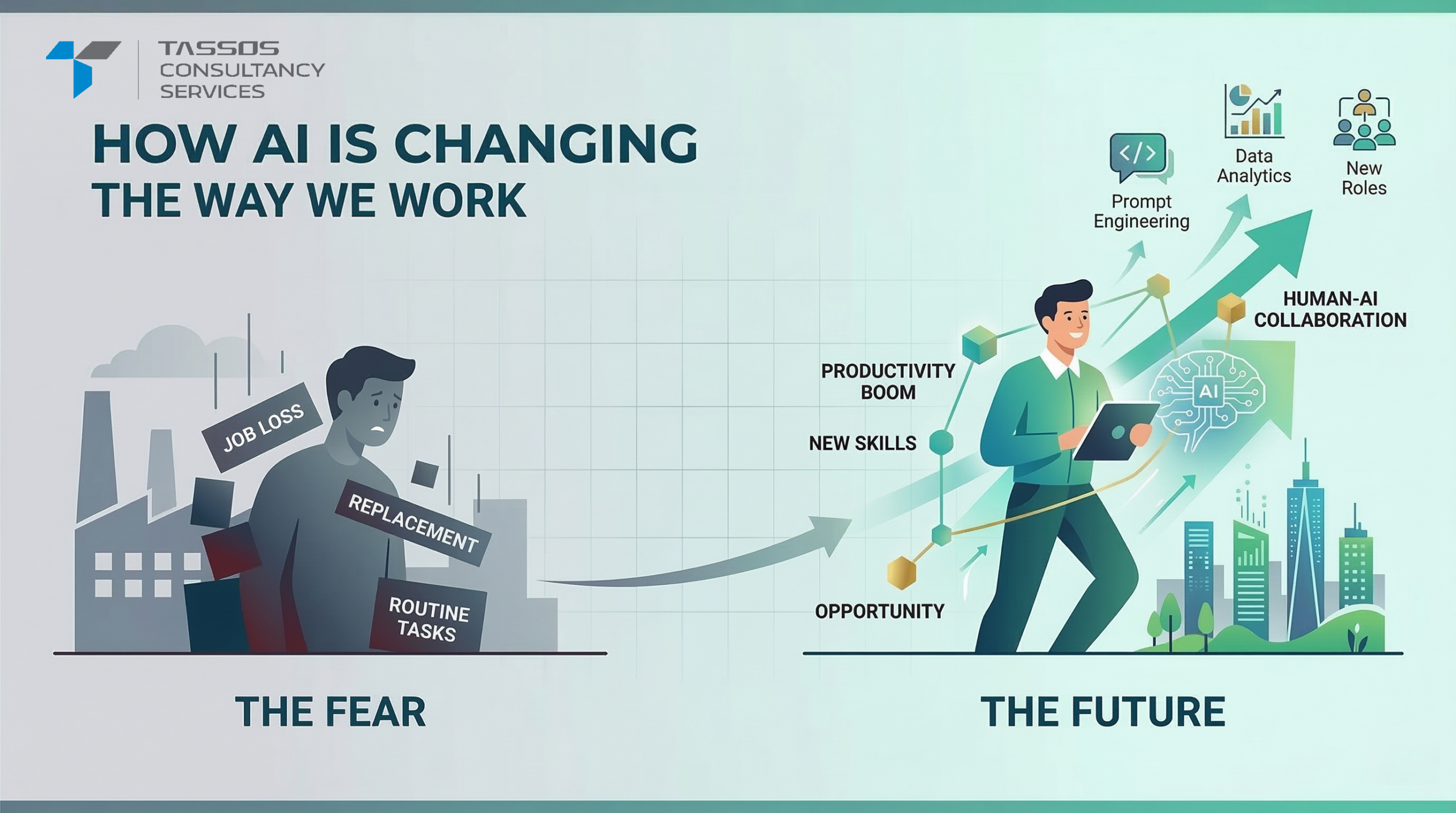
For a long time, people feared that Artificial Intelligence (AI) would take away millions of jobs – especially in India. Since India is one of the biggest countries for software and tech work, many worried that AI would replace a huge number of workers who do routine computer tasks.
But new research tells a very different story.
A major study done in 2026 by a research group called ICRIER, with support from OpenAI, looked at 651 tech companies across 10 big Indian cities. Their finding? AI is not causing mass job losses. Instead, it is changing what jobs look like and what skills people need.
The Big Fear Was Wrong
The study’s most important finding is simple: the scary predictions of millions of jobs disappearing have not come true.
Yes, companies are hiring a little more slowly than before – especially for entry-level positions. But the total number of jobs in the tech industry is still going up, not down.
Researchers also pointed out that the slowdown in hiring is partly because of changes after the COVID-19 pandemic – it is not all because of AI.
How AI Affects Different Job Levels
AI is affecting different types of workers in different ways. Here is a simple breakdown:
- Beginner / Entry-Level Jobs: Companies are hiring fewer beginners because AI can now do many of the simple, repetitive tasks that new employees used to handle.
- Middle-Level Jobs: There is actually MORE demand for experienced workers who know how to use AI tools to manage bigger and more complex work.
- Senior / Leadership Jobs: These roles are barely affected. Decision-making, managing teams, and setting strategy are things AI still cannot do well.
In short, AI is pushing demand upward – toward people with stronger skills – rather than wiping jobs out entirely.
AI Makes Workers More Productive
Instead of replacing workers, AI is helping them get more done in less time. Companies in the study reported better quality work, faster results, and lower costs.
For software developers, the numbers are especially impressive. AI coding tools like GitHub Copilot let developers skip boring, repetitive code and focus on more creative work. The result? Developers using AI finish tasks up to 55.8% faster than those who do not use it.
Here is the most surprising part: the jobs most connected to AI – like software developers, data analysts, and statisticians – are actually growing the fastest. AI is not replacing these workers. It is making them more valuable.
Learning New Skills Is Now Essential
Even though the data is good news, it does not mean workers can relax. The way companies hire people is changing. They no longer just want someone who can write code. They want people who can use AI tools AND think creatively.
The Most Wanted Skills in 2026
According to the study, here are the top skills companies are looking for:
- Prompt Engineering (talking to AI tools effectively) – Needed by 68% of companies. This is the single most in-demand skill right now.
- Data Analytics (reading and understanding data) – Important for 36% of job roles, to make sense of what AI produces.
- Data Science & Machine Learning – Required for 35% of technical jobs.
The Training Problem
Here is the concerning part: only 4% of tech companies have trained more than half of their staff in AI skills. That is a very small number. The main reasons companies are not training their workers fast enough:
- Training programs are expensive
- There are not enough good AI teachers and trainers
- Many organizations are simply not ready for such a big change
Closing this gap is urgent – for both companies and the government.
Real Stories: How AI Is Already Changing Work in India
Sometimes numbers alone do not tell the full story. To really understand what AI is doing to the Indian tech world, it helps to look at what is actually happening on the ground – inside real offices, with real workers, on real projects.
The Developer Who Doubled His Output
Imagine a software developer in Bengaluru who used to spend three to four hours every day writing the same types of basic code – the kind of code that every app needs but no one finds exciting. It was necessary work, but it was slow and draining.
After his company gave him access to an AI coding assistant, everything changed. The AI handled the repetitive parts automatically, in seconds. This freed him to spend his time solving real problems – fixing tricky bugs, designing better systems, and thinking creatively about what users actually need. By the end of just one month, he had completed work that would normally have taken him two full months to finish.
This is not a rare case. Across India’s tech industry, developers using AI tools are reporting similar experiences. They feel less stressed, more creative, and more confident in their output. Many say the job has become more enjoyable because they spend less time on dull tasks and more time on the parts of the work that actually challenge and excite them.
The Customer Support Team That Did Not Shrink
One very common fear is that AI chatbots will replace all customer support workers. But the reality is more interesting. A mid-sized IT company in Pune introduced an AI chatbot to handle basic customer questions – things like resetting passwords or checking invoice status. Straightforward stuff.
Instead of letting staff go, the company moved those workers to handling harder, more emotional customer problems that the chatbot simply could not deal with – things like billing disputes, urgent technical failures, or upset customers who needed a human voice. The result? Staff felt more valued, not less. They were no longer spending their day answering the same question 50 times. They were actually helping people in a meaningful way.
This is what researchers call the “task shift” effect. AI takes over the boring, routine parts of a job, and humans naturally move up to the more thoughtful, caring, and creative parts. Both the workers and the customers end up better off.
Brand New Jobs That Did Not Exist 5 Years Ago
One of the most exciting parts of the AI era is the brand-new types of jobs it is creating. Just five years ago, nobody had a job title called “AI Prompt Engineer” or “AI Quality Checker.” Today, these are some of the fastest-growing and best-paying roles in the tech industry.
Here are some of the new job roles that are quickly becoming common across Indian IT companies:
- AI Prompt Engineer: A person who writes clear, clever instructions to get the best results from AI tools. Think of it like learning a new language – the language of AI. Companies pay very well for people who are good at this.
- AI Quality Checker: Someone who reviews AI-generated work to make sure it is accurate, fair, and safe before it reaches real customers. This role requires careful attention and strong judgment.
- AI Trainer / Data Labeller: A person who feeds AI systems with the right information so the AI can learn correctly. This is a huge and rapidly growing field, especially in smaller cities across India.
- Human-AI Collaboration Manager: A team leader who decides how to divide work between human employees and AI tools in the smartest way possible. This is a leadership role that needs both tech knowledge and people skills.
These roles all require creativity, judgment, empathy, and human understanding – things that AI does not have and is not likely to develop anytime soon. They are clear proof that the rise of AI is not just changing old jobs, but actively building new ones from scratch.
AI Skills Mean Higher Pay
Here is another fact that might surprise you: workers who have AI skills are already earning significantly more than those who do not. Across India’s major tech cities – Bengaluru, Hyderabad, Pune, and Chennai – job listings that mention AI skills offer salaries that are 20% to 40% higher on average compared to similar roles without that requirement.
This is a strong and clear signal from the market. Companies are not just saying they want AI skills – they are willing to open their wallets for them. For young workers and fresh graduates, this is one of the clearest signs that learning AI tools is one of the smartest investments they can make in themselves right now.
A New Door Opening for Women in Tech
Experts also point out something particularly encouraging about the AI era: it could open more doors for women in the tech industry than ever before. Many of the new AI-related roles – like quality checking, content review, data labelling, and AI ethics – tend to value strong communication, careful attention to detail, and ethical thinking. These are areas where women have historically excelled, but have sometimes been pushed aside in a field that over-valued pure coding speed above everything else.
If companies make a real effort to train and hire women for these new AI roles, the tech industry could become meaningfully more diverse, more balanced, and ultimately more successful than it has ever been. The AI revolution might just be the moment when India’s tech world finally becomes a place where everyone can thrive.
The Big Picture: Humans + AI = The Future
The 2026 study confirms something important: AI is following the same path as big technologies before it – like electricity and the internet. When those technologies arrived, people feared job losses too. But over time, they created far more jobs than they ever destroyed.
For Indian tech workers, the message is clear and hopeful. The future is not about AI replacing you. It is about you using AI to become even better at your job.
The workers who learn to work with AI – not against it – will be the ones who thrive. And if companies and the government invest in training people properly, this AI age will be remembered not as the era that took jobs away, but as the era that unlocked human potential like never before.
Keywords:
Generative AI, India IT sector, job transformation, ICRIER study 2026, AI productivity, IT hiring trends, software developer growth, AI reskilling, workforce transformation, OpenAI India research, tech layoffs myth, future of work, AI in India, automation vs augmentation, hybrid skill profiles, digital literacy, entry-level hiring, mid-level recruitment, senior-level stability, AI skill penetration, prompt engineering skills, data analytics, machine learning, IT sector growth, software engineering AI, automated coding, predictive analytics, Indian tech industry, digital economy, upskilling initiatives, AI governance, workforce development, technology disruption, economic impact of AI, IT professionals, software analyst demand, productivity tools, tech workforce India, AI training, OpenAI IT study, future skills 2026, tech industry outlook, software maintenance, AI-driven innovation, employment growth India, digital transformation, labor market trends, tech career progression, coding efficiency, AI integration.


0 Comments