

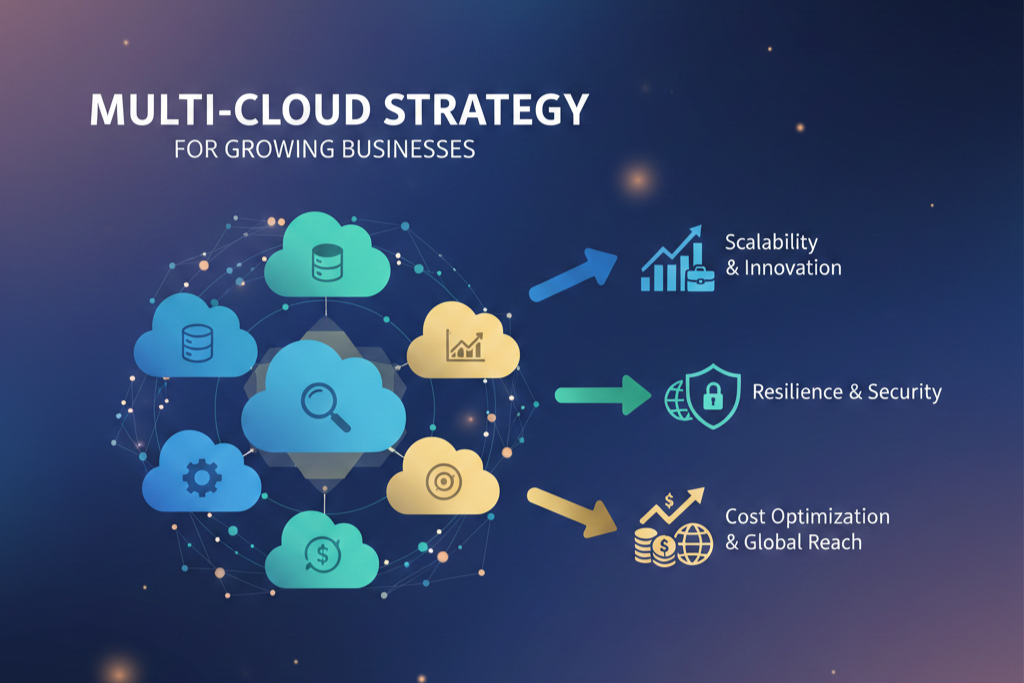
A multi‑cloud strategy means intentionally using more than one cloud provider to run your applications and data, and for growing businesses this is quickly shifting from “nice to have” to “must have.” While a single‑cloud setup is simpler at the beginning, it can limit flexibility, increase risk, and weaken your negotiating power as the company scales.
From cloud adoption to multi‑cloud reality
Most businesses start their cloud journey with one major provider because it is faster to set up, easier to manage, and requires fewer specialized skills. Over time, however, new needs emerge: advanced analytics, AI services, global expansion, stricter compliance rules, and better uptime expectations from customers. Relying on a single platform in this context can feel like trying to grow a company in a building with only one exit and one power line.
Multi‑cloud changes this dynamic by allowing companies to mix and match services from different providers based on strengths, price, and location. Instead of treating the cloud as one big monolith, businesses can choose a provider that is great at AI, another that offers attractive storage pricing, and another with strong regional data centers for latency or compliance. This approach is especially relevant in 2025–26, as reports show multi‑cloud adoption rising sharply and the multi‑cloud management market projected to grow from around 16 billion dollars in 2025 to over 140 billion by 2034.
Avoiding vendor lock‑in and gaining leverage
Vendor lock‑in is one of the most underestimated risks of a single‑cloud strategy. When most workloads, data, and internal skills are tied to one provider’s proprietary services, it becomes difficult and costly to move away, even if prices rise or service quality falls. A multi‑cloud strategy, by contrast, treats cloud providers more like interchangeable partners than a single point of dependency, giving businesses the ability to negotiate better terms and switch or rebalance workloads when needed.
This freedom is not only financial but also technical. Different clouds innovate at different speeds in areas such as machine learning, databases, serverless, and edge computing, and committing to one ecosystem can mean missing out on best‑of‑breed capabilities elsewhere. With multi‑cloud, growing businesses can tap into the strongest features of each provider without having to rewrite everything whenever they want to adopt a new service.
Resilience, continuity, and compliance by design
For customer‑facing applications, downtime quickly translates into lost revenue and damaged trust, and large cloud providers do experience outages. Multi‑cloud architectures help reduce this risk by running critical workloads across more than one platform, allowing traffic to fail over automatically if one provider has problems. Case studies already show organizations reducing downtime significantly by replicating data and services across clouds so that a failure in one environment does not halt operations.
Regulatory and data sovereignty requirements add another layer of pressure, especially for sectors like finance, healthcare, and government. Sometimes a single cloud cannot meet all regional or industry certifications needed for a growing business operating in multiple countries. By choosing providers with specific local data centers or compliance badges, a multi‑cloud strategy allows companies to place workloads where regulations demand, without waiting for one vendor to catch up.
Performance, cost optimization, and the SME angle
Performance is another reason multi‑cloud matters. Not all clouds have the same network footprint, peering relationships, or strengths in specific workloads, and deploying everything on one platform can lead to latency or cost inefficiencies. By distributing workloads to the clouds that handle them best—such as compute‑heavy tasks on one provider and analytics or AI on another—businesses can improve response times and user experience.
Contrary to the assumption that multi‑cloud is only for enterprises, more small and medium‑sized businesses are adopting it for flexibility, resilience, and cost control. As their needs grow beyond basic hosting, SMEs find that a single provider becomes limiting, whereas a well‑planned multi‑cloud setup lets them use specialized services, avoid price traps, and align infrastructures with regional regulations without enterprise‑level budgets.
When multi‑cloud is smart—and when it is not
Despite its advantages, multi‑cloud is not automatically the right choice for every business at every stage. It introduces additional complexity in areas such as monitoring, identity management, networking, and cost tracking, and organizations without mature DevOps or cloud practices may struggle to manage this overhead. For very early‑stage companies with simple workloads, a single‑cloud approach can still be the most practical option until scale and risk justify the extra effort.
However, once a business reaches a certain level of growth—multiple products, regions, compliance constraints, and higher uptime expectations—the question often shifts from “Do we really need multi‑cloud?” to “Can we afford not to have it?” At that point, multi‑cloud stops being a buzzword and becomes a strategic tool for resilience, bargaining power, innovation, and long‑term independence in the cloud era.
***
Keywords :
multi cloud strategy, multi cloud architecture, multi cloud computing, cloud strategy for businesses, multi cloud adoption, multi cloud management, cloud infrastructure strategy, enterprise multi cloud, hybrid and multi cloud, cloud vendor lock in, avoiding vendor lock in cloud, multi cloud benefits, cloud resilience strategy, cloud business continuity, multi cloud disaster recovery, cloud failover systems, multi cloud security, cloud compliance strategy, data sovereignty cloud, regulatory compliance cloud, cloud risk management, cloud scalability solutions, cloud flexibility strategy, best of breed cloud services, cloud cost optimization, cloud performance optimization, multi cloud cost management, cloud workload distribution, distributed cloud architecture, cloud infrastructure optimization, cloud provider comparison, SME cloud strategy, small business multi cloud, growing business cloud solutions, cloud negotiation leverage, cloud independence strategy, multi cloud for startups, cloud operations management, multi cloud DevOps, cloud monitoring solutions, cloud identity management, cloud networking strategy, multi region cloud deployment, global cloud infrastructure, cloud modernization strategy, future of cloud computing, cloud transformation roadmap, cloud governance framework, multi cloud innovation, enterprise cloud platforms, next generation cloud architecture, digital transformation cloud, cloud service portability, cloud workload portability, resilient cloud systems.

0 Comments