

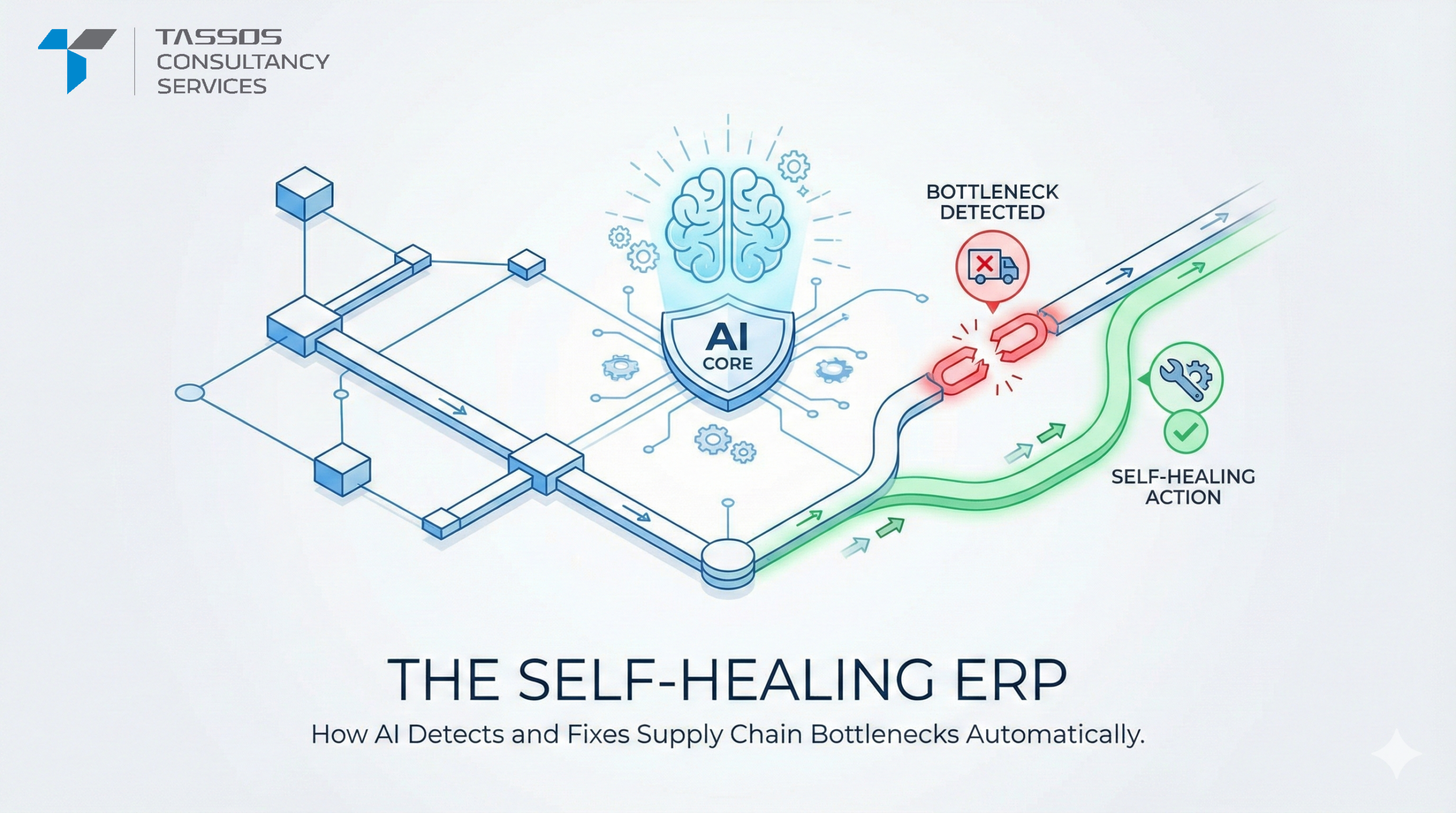
The modern supply chain is fragile. A delayed chip shipment in Taiwan can stop car production in Detroit. A port strike in Europe can empty store shelves in Australia. For decades, ERP systems have tracked this data, but they have one major problem: they only react after things go wrong.
Now, there’s a better way: the Self-Healing ERP. Using AI and machine learning, these systems don’t just report problems—they predict and fix them automatically before they cause damage.
From Tracking Data to Taking Action
Traditional ERPs are record keepers. They tell you what happened yesterday. Self-healing ERPs are different—they use real-time data from sensors, predict what will go wrong tomorrow, and fix it today.
Here’s how the technology works:
- Smart Sensors: Devices on trucks, in warehouses, and on factory floors collect live data
- Fast Processing: Local computers analyze data instantly instead of waiting for cloud servers
- AI Decisions: The system takes immediate action to solve problems
The Three-Step Healing Process
1. Detect the Problem Early
The AI watches everything—inventory levels, production speeds, weather patterns, supplier performance. It spots trouble before humans can. If a supplier always ships late during rainy season, the AI learns this pattern and prepares months in advance.
2. Diagnose the Cause
When the system predicts a problem, it figures out why. Is it a shipping delay? A machine about to break? A sudden spike in demand? The AI analyzes all possibilities at once.
3. Fix It Automatically
This is where self-healing happens:
- Reroute shipments through alternate ports when one gets congested
- Order from backup suppliers before you run out of stock
- Shift production to working machines when one shows signs of failure
No emails. No meetings. No delays. Just instant action.
Real Examples in Action
Smart Warehouses: When a conveyor belt sensor detects unusual vibrations, the system redirects packages to another line, slows the failing belt to extend its life, and schedules a repair—all in seconds.
Delivery Fleets: Traffic accident blocking the main route? The system instantly sends new directions to all trucks, keeping deliveries on time.
Supplier Backup: AI detects a likely strike at your supplier and automatically reserves capacity at an alternate facility before the strike happens.
Why Speed is Everything
Self-healing only works with fast technology:
- 5G Networks: Cut response time from 50 milliseconds to just 1 millisecond
- Edge Computing: Process data locally instead of sending it to distant servers
- High Bandwidth: Handle massive amounts of real-time data
Without this speed, you can’t fix problems in real-time. By the time data travels to a cloud server and back, the problem has already grown.
Building Trust in AI
The biggest challenge isn’t technology—it’s getting people to trust AI decisions.
Modern self-healing ERPs solve this with Explainable AI. Every decision comes with a clear reason: “Rerouted shipment because 95% chance of major storm hitting Miami Port in 48 hours.”
Think of it like this: the AI shows its work, just like a student solving a math problem. You can see why it made each choice.
The Bottom Line
Self-healing ERPs end the age of constant crisis management. Instead of reacting to problems, you prevent them. Instead of scrambling for solutions, your system handles it automatically.
The benefits are clear:
- Problems get fixed before they escalate
- No more emergency meetings at 2 AM
- Supply chains run smoothly even during disruptions
- Your team focuses on strategy, not firefighting
The future isn’t about managing problems better—it’s about having fewer problems to manage. Companies using self-healing ERPs won’t just survive the next disruption. They might not even notice it happened.
The question now: How quickly can your business adopt this technology before your competitors do?
Keywords :
Self-healing ERP, AI in supply chain, autonomous supply chain, predictive analytics, supply chain bottlenecks, machine learning in ERP, automated remediation, cognitive ERP systems, smart manufacturing, supply chain resilience, predictive maintenance, real-time logistics, ERP automation, digital supply chain transformation, Industry 4.0, IoT in supply chain, edge AI analytics, data-driven decision making, inventory optimization, algorithmic supply chain, automated procurement, disruption management, intelligent ERP, cloud ERP solutions, next-gen resource planning, supply chain agility, cyber-physical systems, automated workflow, demand forecasting AI, logistics optimization, smart warehousing, ERP integration, operational efficiency, self-correcting systems, digital twin technology, prescriptive analytics, supply chain visibility, AI-driven logistics, enterprise AI, future of ERP, supply chain risk management, adaptive supply networks, automated order fulfillment, real-time data processing, smart inventory management, autonomous enterprise, business continuity, intelligent automation, supply chain orchestration.
0 Comments