

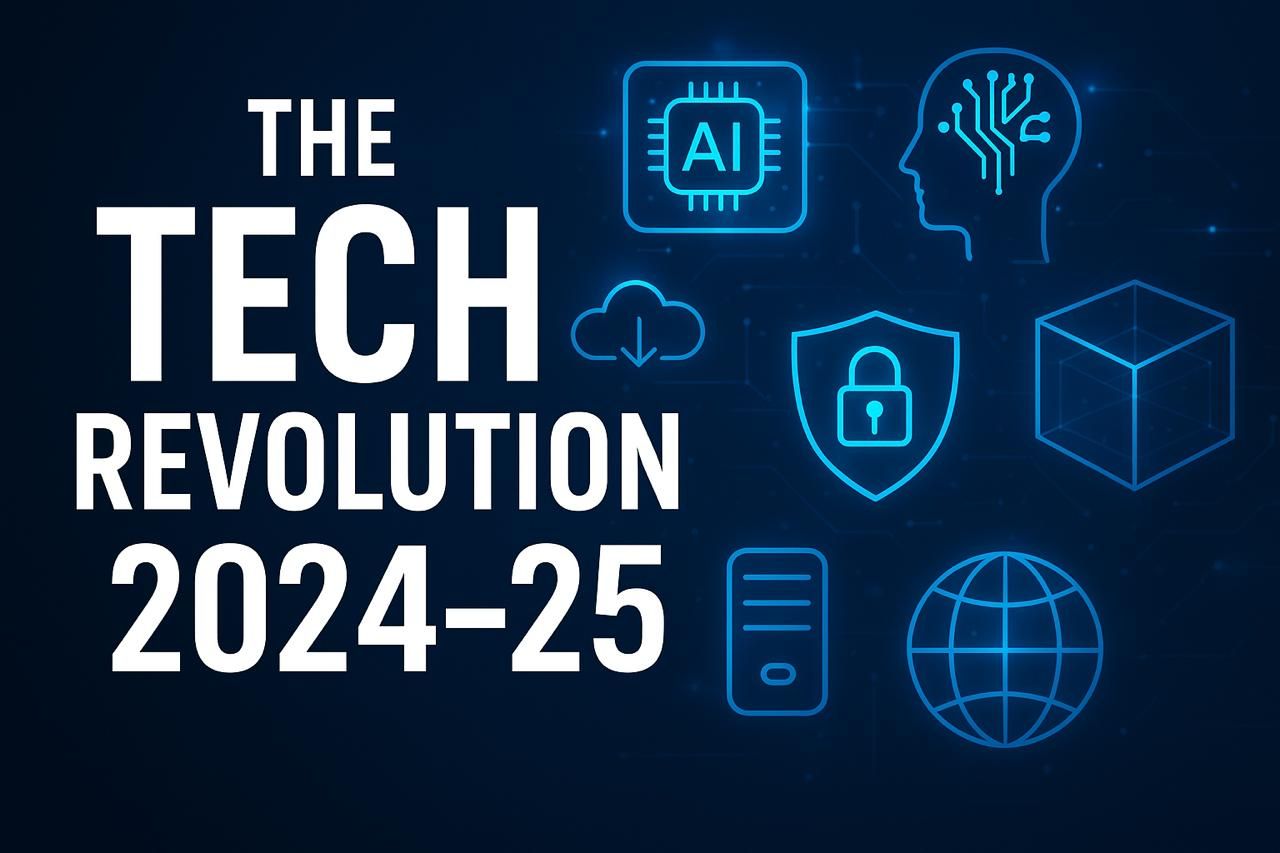
The technological landscape is evolving at an unprecedented pace, driven by breakthrough innovations that are fundamentally transforming how we live, work, and interact with the digital world. Understanding these emerging technologies is no longer optional—it’s essential for staying competitive in today’s rapidly changing environment.
Artificial Intelligence: The Engine of Innovation
AI has evolved from a simple tool into a comprehensive digital workforce driving automation, creativity, analytics, and innovation across every industry.
Leading AI Trends
Agentic AI enables systems to plan, decide, and act autonomously without constant human oversight, revolutionizing workflow automation.
Multimodal AI processes text, images, audio, and video simultaneously, creating more natural and intuitive human-computer interactions.
Edge AI brings real-time processing directly to cameras, drones, and IoT devices, enabling instant decision-making without cloud dependency.
Generative AI creates original content, including text, video, code, and design elements, accelerating creative and development processes.
Large Language Models like ChatGPT, Gemini, DeepSeek, and Claude are transforming customer service, content creation, and business intelligence.
AI is reshaping medicine, finance, operations, cybersecurity, software development, and product design, delivering measurable improvements in efficiency and innovation.
Spatial Computing: Beyond the Screen
Spatial computing technologies—including Augmented Reality (AR), Virtual Reality (VR), and Extended Reality (XR)—are redefining how we interact with digital information by integrating it seamlessly into our physical environment.
Key Developments
Apple Vision Pro and similar devices are pioneering new interaction paradigms that blend digital and physical worlds. Digital twins create virtual replicas of physical systems for testing and optimization. Metaverse infrastructure is maturing, enabling persistent virtual environments for collaboration and commerce.
Real-World Impact
Medical and engineering professionals use spatial computing for immersive training simulations. Retailers create engaging virtual showrooms and product experiences. Architects visualize designs at full scale before construction begins. Industrial facilities monitor operations through real-time 3D overlays.
Cybersecurity: The AI-Powered Defense
As cyber threats grow more sophisticated, security strategies are shifting from reactive responses to proactive, AI-driven protection.
Critical Security Trends
Zero-Trust Architecture assumes no user or device is trustworthy by default, requiring continuous verification at every access point.
Multi-Factor Authentication and biometric security add layers of protection beyond traditional passwords.
AI-Based Threat Detection identifies anomalies and potential attacks before they cause damage, while adversaries similarly leverage AI for attacks—creating an ongoing technological arms race.
Cloud Security and ransomware defense mechanisms are evolving to protect increasingly distributed infrastructure.
Cloud Infrastructure and DevOps: Digital Operations at Scale
Modern cloud platforms combined with DevOps and Site Reliability Engineering (SRE) practices enable organizations to build, deploy, and maintain systems that are fast, reliable, and scalable.
Infrastructure Evolution
Major cloud providers—AWS, Azure, and Google Cloud—offer increasingly sophisticated services. Kubernetes and microservices architectures enable flexible, scalable applications. Serverless computing eliminates infrastructure management overhead. CI/CD automation accelerates development cycles while maintaining quality.
SRE principles ensure high availability, automatic scaling, fault tolerance, and streamlined deployment processes.
Quantum Computing: Unlocking New Possibilities
Quantum systems are transitioning from research laboratories to early commercial applications, promising to solve problems beyond the reach of classical computers.
Quantum Applications
Quantum computing enables unprecedented computational power for financial modeling, chemical simulations, and optimization problems. Post-quantum cryptography is being developed to secure systems against future quantum threats. The integration of quantum capabilities with AI could revolutionize machine learning, climate modeling, and drug discovery.
Blockchain and Web3: Digital Ownership Infrastructure
Blockchain technology extends far beyond cryptocurrency, creating new paradigms for digital ownership, identity, and trust.
Web3 Innovations
Smart contracts automate complex agreements without intermediaries. Decentralized Finance (DeFi) reimagines banking and financial services. NFTs and asset tokenization enable new forms of digital ownership. Decentralized identity systems give users control over their personal data. Layer-2 networks improve blockchain scalability and efficiency.
These technologies are transforming finance, supply chain management, gaming economies, and secure data exchange.
Hyperconnectivity: 5G to 6G Networks
Next-generation wireless networks provide the bandwidth and low latency required for emerging technologies, powering autonomous vehicles, smart cities, real-time holography, and industrial IoT applications.
AIoT: Intelligence at the Edge
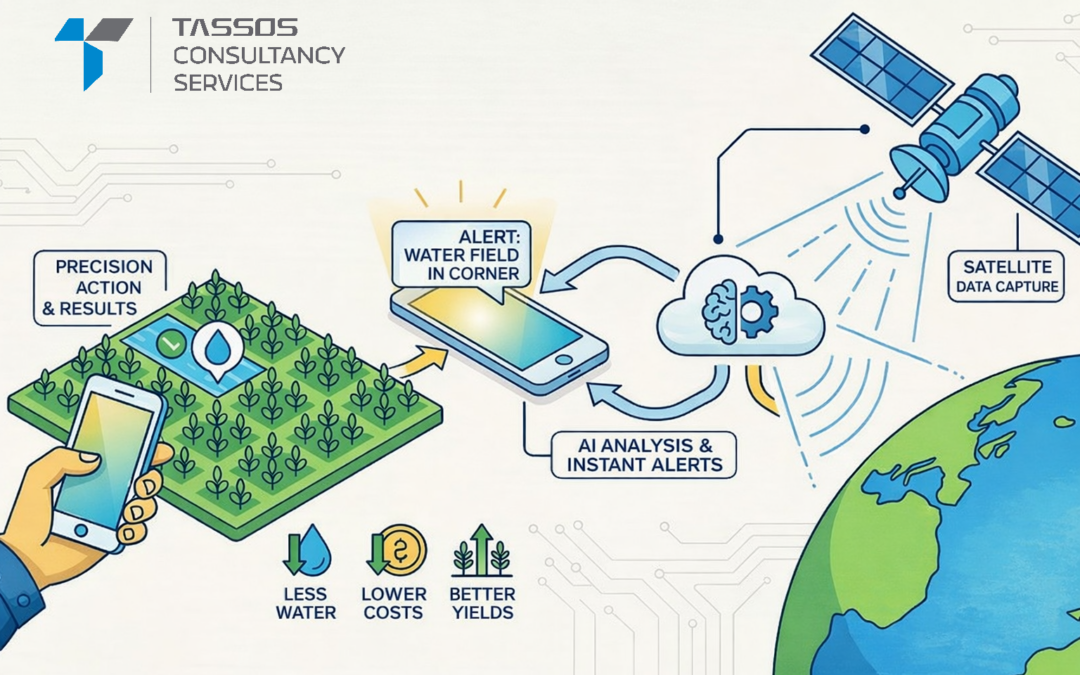
The convergence of AI and IoT creates smart devices capable of real-time intelligent decision-making across smart homes, precision agriculture, healthcare monitoring, industrial automation, and predictive maintenance systems.
The Enduring Fundamentals
Despite rapid innovation, foundational technologies and platforms continue to dominate: software development, IT infrastructure, and established platforms like YouTube, Google, Meta, and enterprise tools now enhanced with AI capabilities such as Canva, Notion, and Excel.
Conclusion: Embracing the Revolution
The current technological revolution is built on six foundational pillars: intelligent machines, hyperconnected systems, immersive digital experiences, proactive cybersecurity, quantum computation, and decentralized infrastructure.
Mastering these technologies is essential for career advancement, business innovation, and maintaining competitiveness in an increasingly digital world. Organizations and individuals who embrace these changes will thrive, while those who resist risk obsolescence.
The question is not whether to engage with these technologies, but how quickly you can leverage them to create value and drive meaningful innovation.
***
Keywords :
emerging technologies 2025, future technology trends, artificial intelligence innovation, AI technology trends, agentic AI systems, multimodal AI technology, generative AI applications, edge AI computing, large language models, spatial computing technology, augmented reality AR, virtual reality VR, extended reality XR, Apple Vision Pro technology, digital twin technology, metaverse infrastructure, immersive computing solutions, cybersecurity technology trends, AI cybersecurity solutions, zero trust security architecture, cloud security systems, ransomware protection technology, cloud infrastructure platforms, DevOps and SRE, Kubernetes microservices, serverless computing, CI CD automation, site reliability engineering, quantum computing applications, post quantum cryptography, quantum AI integration, blockchain technology use cases, Web3 infrastructure, decentralized finance DeFi, smart contracts blockchain, NFT and tokenization, decentralized identity systems, hyperconnectivity networks, 5G technology applications, future 6G networks, AIoT solutions, artificial intelligence of things, edge intelligence systems, smart city technology, industrial IoT solutions, intelligent automation systems, digital transformation technology, next generation computing, advanced computing technologies, enterprise technology trends, immersive digital experiences, decentralized infrastructure, future of innovation technology, intelligent systems architecture.
0 Comments