

Global seafood demand is racing toward 200 million tons by 2030, but traditional fish farming can’t keep up. Manual water testing, guesswork feeding, and reactive disease management are hitting their limits. The solution? Smart Ponds—where IoT sensors, automated feeding, and AI computer vision converge to create intelligent, self-optimizing aquaculture systems.
This isn’t just automation. It’s real-time intelligence that maximizes growth, minimizes losses, and ensures sustainability.
How Smart Pond Technology Works
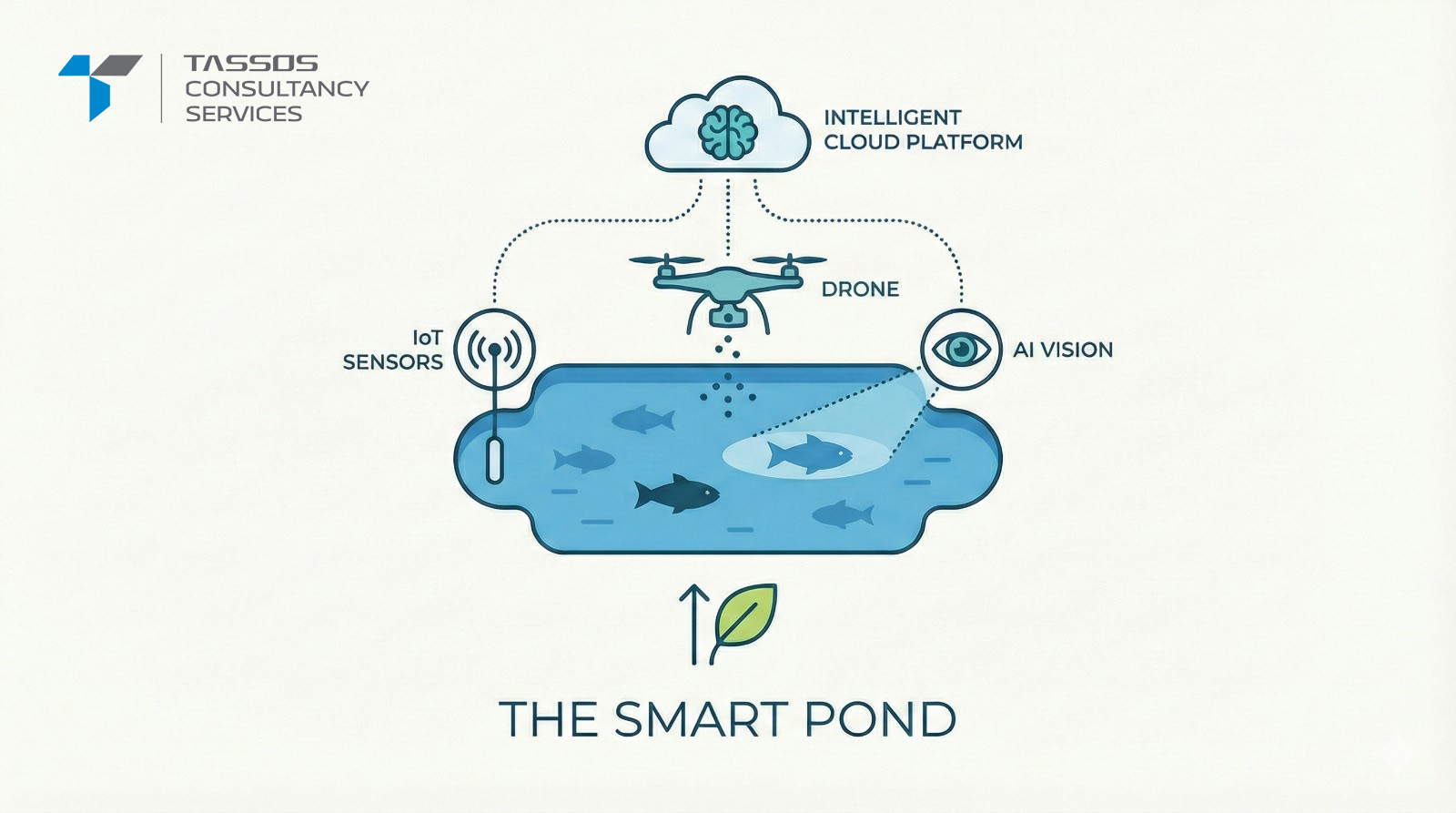
A Smart Pond operates as an integrated ecosystem where four technologies work together:
IoT sensors monitor water quality 24/7—temperature, dissolved oxygen, pH, ammonia, and turbidity. Unlike manual testing that captures snapshots, sensors deliver continuous real-time data.
Automated feeding systems deliver precise nutrition based on sensor data and fish behavior, eliminating costly overfeeding and growth-stunting underfeeding.
AI computer vision analyzes underwater camera feeds to detect fish behavior, health issues, and feeding patterns that human observation misses.
Cloud platforms fuse all data into actionable insights, sending alerts and enabling remote monitoring from anywhere.
Together, they transform traditional ponds into intelligent environments that adapt automatically.
IoT Sensors: Preventing Problems Before They Happen
Water conditions can change dramatically within hours. A sudden algae bloom crashes oxygen levels overnight. Equipment failure spikes ammonia before the next manual test. By the time periodic testing detects problems, fish may already be dying.
IoT sensors eliminate this blind spot by monitoring critical parameters continuously:
- Dissolved oxygen (the most critical survival parameter)
- Temperature (affects metabolism and oxygen demand)
- pH levels (influences toxicity and nutrient availability)
- Ammonia/nitrate (toxic byproducts from waste)
- Turbidity (indicates algae blooms or sediment issues)
One farmer prevented a dissolved oxygen crash that would have killed 80% of his stock—the system detected the trend and triggered aeration automatically at 2 AM while he slept. Early detection means early intervention.
Automated Feeding: Cutting Costs, Boosting Growth
Feeding represents 50-70% of aquaculture costs, yet traditional practices are remarkably imprecise. Overfeeding wastes money and degrades water quality. Underfeeding slows growth and extends time to market.
Smart feeders integrate multiple data sources to make precise decisions:
- Water temperature adjusts feeding rates (metabolism slows in cold water)
- Dissolved oxygen levels trigger feeding delays if conditions aren’t optimal
- AI vision detects whether fish are actively eating or ignoring food
- The system learns continuously—adapting schedules based on what works
Real Results:
- 20-30% reduction in feed waste
- Improved feed conversion ratio from 1.8:1 to 1.4:1
- 75% less labor on feeding tasks
- One Southeast Asian operation saved $45,000 annually (22% cost reduction)
AI Computer Vision: Seeing What Humans Cannot
Traditional farming relies on brief visual assessments from the surface. AI computer vision analyzes video continuously, identifying patterns invisible to human observation.
What AI Detects:
Behavioral anomalies reveal health issues days before visible symptoms. A Norwegian salmon farm detected unusual swimming patterns three days before disease symptoms appeared, containing the outbreak to 5% instead of 40% of the population.
Feeding behavior analysis distinguishes aggressive feeding from disinterest, triggering immediate adjustments.
Biomass estimation measures fish size and counts population accurately without stressful physical sampling.
Uneaten feed detection spots waste immediately, preventing water quality degradation.
AI doesn’t get tired or distracted. It analyzes every frame, comparing current behavior against thousands of hours of data to catch subtle deviations.
Data Integration: Turning Information Into Action
Individual sensors and cameras provide data. The real power comes from data fusion—combining everything into a single intelligent platform.
Farmers get comprehensive operational control:
- Real-time mobile alerts for critical conditions (low oxygen, feeding anomalies, unusual behavior)
- Predictive analytics for growth rates and optimal harvest timing
- AI recommendations for feeding adjustments and water quality interventions
- Historical trend analysis revealing patterns across production cycles
Machine learning makes the system smarter over time. A Smart Pond in its fifth cycle is measurably more accurate than its first—it’s learned the specific characteristics of that pond, those fish, that climate.
Economic and Environmental Impact
Smart Ponds prove profitability and sustainability can align.
Economic Benefits:
- Feed costs drop 20-30%
- Labor requirements decrease 60-80%
- Fish mortality falls 15-25%
- Yield per pond increases 10-20%
A 50-hectare tilapia farm in Thailand documented 28% higher net profit margins after implementation. The investment paid for itself in 18 months.
Environmental Benefits:
- 40-60% reduction in nutrient pollution from excess feed
- Less water exchange and lower ecosystem impact
- Efficient resource use per kilogram produced
- Supports sustainable farming certification
Implementation Challenges
Smart Pond systems require navigating certain hurdles:
Initial investment: $50,000-$200,000 for commercial-scale operations depending on size and sophistication.
Connectivity requirements: Cloud-based systems need reliable internet—challenging in rural areas, though satellite services are expanding.
Technical knowledge: Farmers must understand system operation and troubleshooting, though interfaces are becoming more intuitive.
AI calibration: Vision systems trained on salmon may need retraining for tilapia or catfish.
However, these barriers are decreasing as technology matures, costs drop, and user-friendliness improves.
The Future of Intelligent Aquaculture
The next wave of Smart Pond innovation includes:
Edge AI processing for faster local decision-making that works even without internet connectivity.
Weather integration to anticipate challenges—adjusting feeding before forecasted rain or preparing for heat waves.
Blockchain traceability documenting every feeding and treatment from pond to plate for consumer transparency.
Fully autonomous operations requiring minimal human intervention—the technology already exists; integration and reliability improvements will make this viable within a decade.
The Bottom Line
Smart Ponds represent a fundamental shift from reactive, labor-intensive management to intelligent, predictive precision farming. By integrating IoT sensors, automated feeding, and AI computer vision, fish farmers gain complete operational visibility and control.
The economic case is compelling: reduced costs, increased yields, lower risk. The environmental case is equally strong: less waste, better resource efficiency, healthier ecosystems. The operational transformation is clear: less labor, more control, better outcomes.
This isn’t technology for its own sake—it’s a practical response to meeting global food demand while building genuinely sustainable aquaculture systems. As adoption accelerates, Smart Ponds are redefining what’s possible in aquatic food production. The future of fish farming is intelligent.
***
Keywords :
smart pond technology, smart aquaculture systems, AI in fish farming, IoT in aquaculture, intelligent fish farming, smart pond management, automated aquaculture systems, precision aquaculture, AI aquaculture solutions, digital fish farming, fish farming automation, aquaculture IoT sensors, smart water quality monitoring, dissolved oxygen monitoring aquaculture, automated fish feeding systems, AI feeding optimization, aquaculture computer vision, underwater AI monitoring, fish behavior analysis AI, biomass estimation aquaculture, smart fish pond sensors, real time aquaculture monitoring, predictive aquaculture analytics, cloud based aquaculture platform, edge AI aquaculture, sustainable aquaculture technology, smart aquaculture farming, modern fish farming technology, aquaculture data analytics, precision fish feeding, fish health monitoring system, smart aquaculture IoT platform, AI powered aquaculture, aquaculture automation solutions, digital pond management, smart seafood production, future of aquaculture technology, sustainable fish farming systems, aquaculture yield optimization, fish mortality reduction technology, aquaculture environmental monitoring, intelligent aquaculture platform, smart aquaculture feeding control, aquaculture resource optimization, AI driven fish farming, smart fisheries technology, aquaculture innovation, next generation aquaculture, connected fish farms, smart aquaculture ecosystem, automated pond monitoring, seafood technology innovation, sustainable seafood production, intelligent food farming systems.
0 Comments