

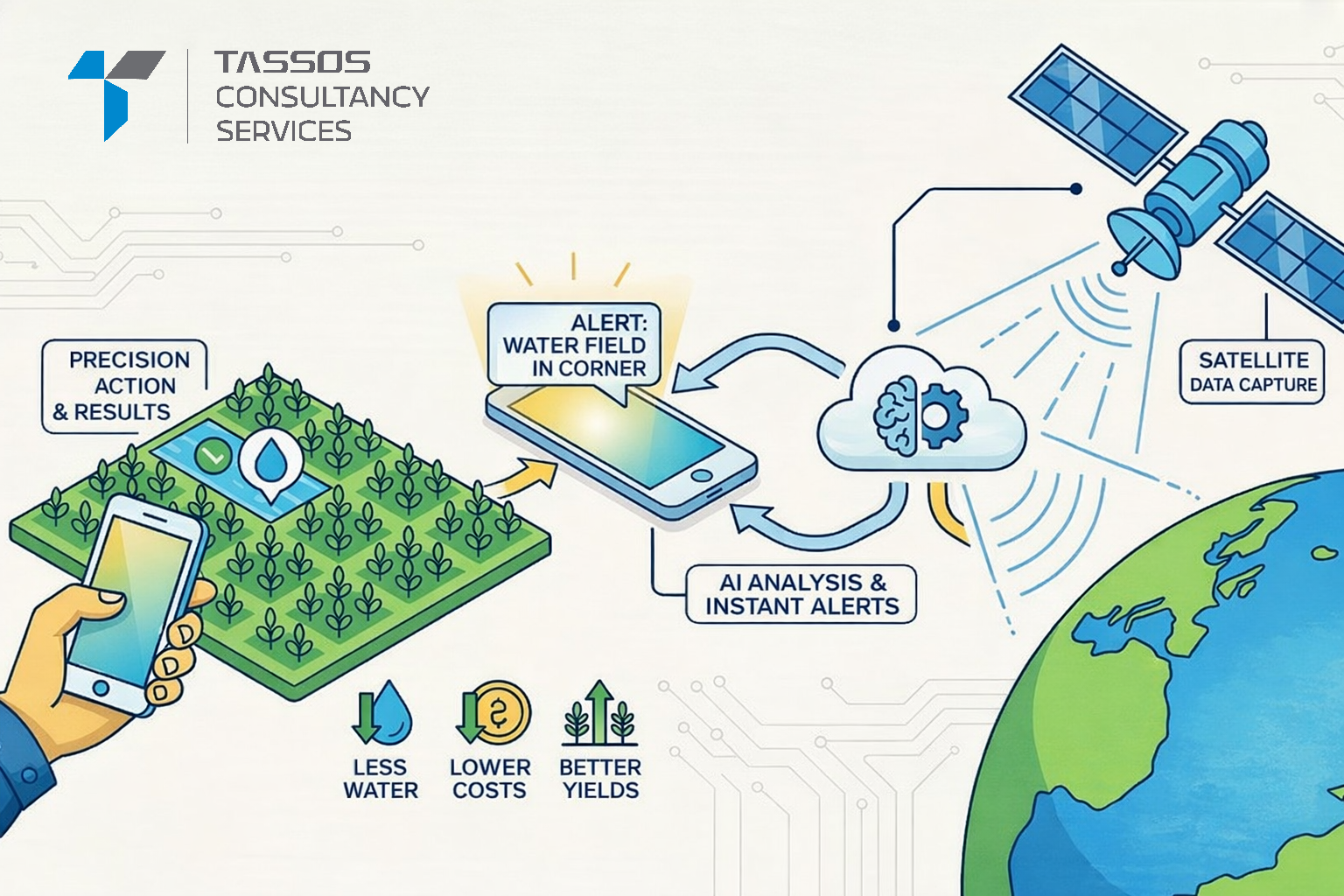
How Satellites Are Helping Farmers Grow Better Crops
Satellite technology was once only for scientists and governments. Today, any farmer with a smartphone can use it to make better decisions about their crops. Satellites in space now work with simple mobile apps to send farmers clear, actionable alerts—no technical knowledge needed.
From Space to Your Phone in Hours
Here’s how the system works:
1. Satellites Capture Images: Satellites circle Earth multiple times daily, taking special photos that reveal plant health, soil moisture, and temperature—things the human eye cannot see.
2. AI Analyzes the Data: Powerful computers process these images and calculate health scores for your crops.
3. AI Identifies Problems: The system spots trouble areas—places that are too dry, diseased, or under stress.
4. You Receive Simple Alerts: Instead of complicated maps, you get a clear message: “Field 4 needs water in the northeast corner within 48 hours.”
This entire process happens in just a few hours.
Four Ways Satellites Help Your Farm
1. Detect Problems Before They’re Visible
Satellites spot disease, pests, or nutrient deficiencies 1-2 weeks before you can see them with your eyes. This early warning lets you take action before problems spread and cause major damage.
2. Optimize Water Use
The system tells you exactly when and where to water based on actual soil moisture levels. No more guessing or following fixed schedules. This saves water, reduces costs, and improves crop health.
3. Receive Field-Specific Weather Alerts
Get warnings about frost, heat waves, or conditions that encourage pests—tailored to your exact location, not just general regional forecasts.
4. Predict Your Harvest
AI estimates your yield weeks before harvest, helping you plan storage, arrange transportation, and negotiate better prices with buyers.
The Results: Better Yields, Lower Costs
Farmers using satellite monitoring systems achieve measurable improvements:
- 12% higher yields on average
- 30% less water through precision irrigation
- 20% lower fertilizer costs by applying only where needed
- Fewer pesticides through early detection and targeted treatment
Old Way vs. Satellite Way
| What You Do | Traditional Method | Satellite Method |
|---|---|---|
| Check crops | Walk fields for hours, miss hidden issues | Instant alerts from anywhere |
| Apply fertilizer | Same amount everywhere | Only where actually needed |
| Water crops | Fixed schedule regardless of conditions | Based on real-time soil moisture |
| Control pests | React after seeing damage | Prevent before visible damage |
Now Affordable for Everyone
High-quality satellite data that once cost thousands of dollars is now free or very affordable through:
- Government agricultural programs
- Free mobile apps with basic features
- Subsidized services for small farmers
Apps are designed for all farmers:
- Available in multiple languages
- Simple interfaces—no training required
- Work offline for areas with poor internet
- Voice alerts for those who prefer listening
Environmental Benefits
Precision farming through satellites doesn’t just save money—it protects the environment:
- Less fertilizer runoff keeps rivers and lakes clean
- Reduced water waste conserves scarce resources
- Targeted pesticide use protects beneficial insects and ecosystems
- Lower carbon footprint through efficient resource management
The Future: Even Smarter Farming
New developments coming by 2030:
Digital Farm Twins: Virtual models of your farm that let you test different fertilizers or irrigation strategies before actually applying them.
Instant Processing: Some analysis will happen directly on satellites, delivering updates to your phone in minutes instead of hours.
Integrated Systems: Satellites will work together with drones for close-up views, soil sensors for ground confirmation, and AI that learns your specific farm’s patterns over time.
Real-World Impact
Consider a typical scenario: A farmer with 100 acres of wheat receives an alert on Tuesday morning that a 15-acre section shows early water stress. Instead of irrigating the entire field (wasting water and money), they water only that section. By Friday, the stressed area has recovered, and the farmer has saved thousands of gallons of water and prevented yield loss in that zone.
This precision—knowing exactly where and when to act—is what makes satellite technology transformative.
Conclusion
Satellite technology has transformed from a space-age luxury to an everyday farming tool. What once required expensive equipment and expert knowledge now arrives as a simple text message on your phone.
Keywords :
Satellite data for farmers, precision agriculture apps, remote sensing in farming, satellite crop monitoring, NDVI for farmers, smart farming mobile apps, real-time crop health, satellite soil moisture analysis, agricultural data analytics, AI in farming apps, space-based agriculture, variable rate application, crop yield prediction, digital farming tools, farm management software, automated crop alerts, satellite imagery for agriculture, mobile GIS for farmers, multispectral satellite data, vegetation index monitoring, water stress detection, drought monitoring satellites, smart irrigation apps, precision farming technology 2026, satellite-powered farm advisory, hyper-local weather for farmers, digital twin farms, sustainable agriculture technology, satellite pest detection, nitrogen management apps, satellite-based land mapping, remote farm monitoring, farmer WhatsApp alerts, satellite data API for agtech, cloud-based farm analytics, satellite remote sensing benefits, smallholder agtech solutions, satellite-driven yield forecasting, planetary-scale crop monitoring, high-revisit satellite imagery.
0 Comments