

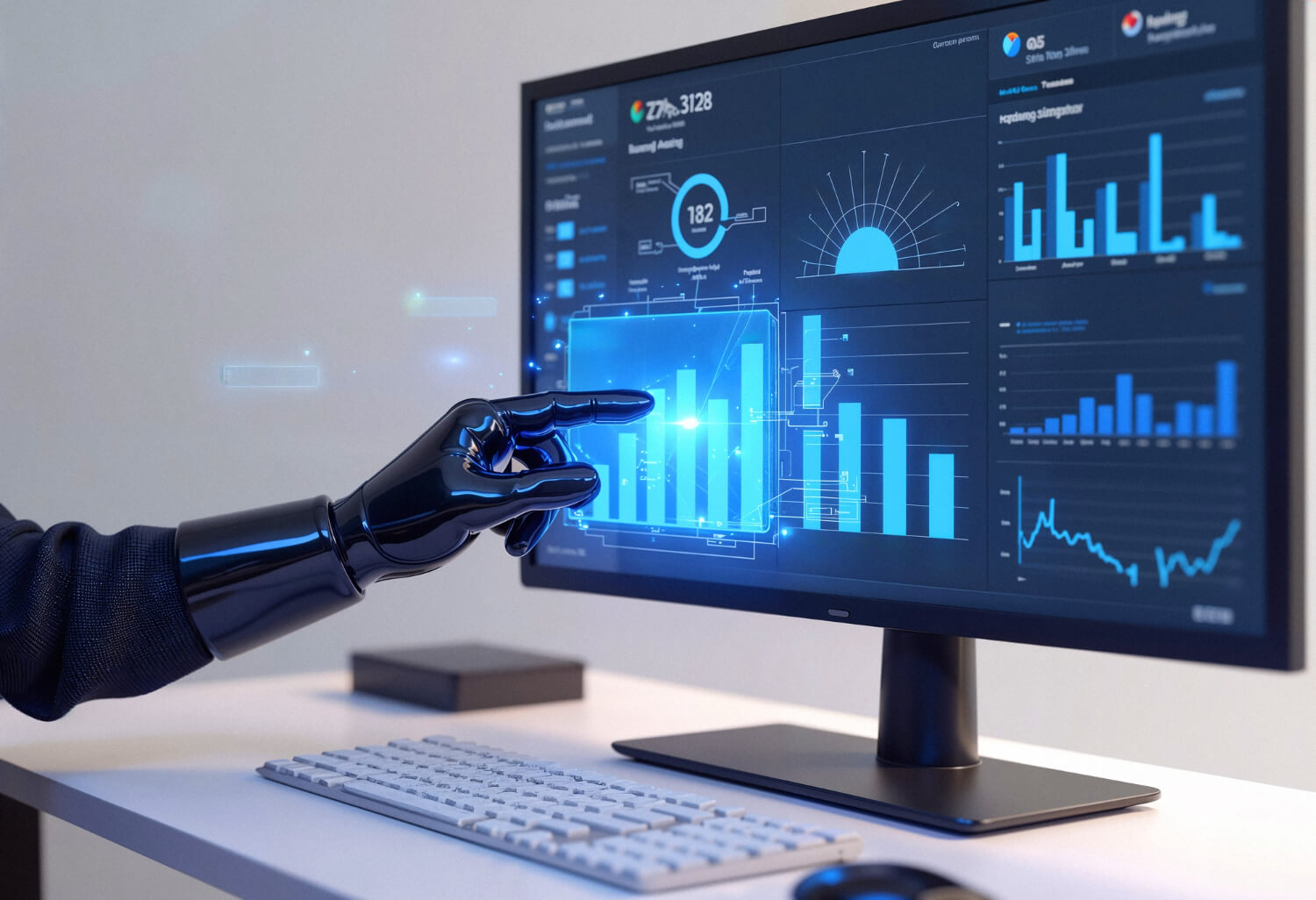
ERP systems bring important business functions such as procurement, inventory, production, sales, finance, HR, and quality management into one connected platform.
But having all this data in one system creates another opportunity: using AI to make that information easier to understand and act upon.
Tassos ERP is being enhanced with AI capabilities designed to help businesses move beyond simply recording transactions. The goal is to make ERP more conversational, predictive, proactive, and actionable.
Ask Your ERP in Plain English
Finding information in a traditional ERP often means navigating modules, applying filters, and opening multiple reports.
With an AI Data Assistant, users can simply ask questions such as:
“Which materials are currently low in stock?”
“How much production was completed this month?”
“Which customers have pending payments?”
“Which purchase orders are delayed?”
The AI can identify the relevant ERP information and provide an understandable response.
This makes business data more accessible to managers and employees without requiring them to understand complex reports or database structures.
Generate Reports and Charts on Demand
Business questions are not always covered by predefined dashboards.
AI can allow users to request their own analysis using natural language.
For example:
“Show sales trends for the last six months.”
“Compare planned production with actual production.”
“Show the top five materials by consumption.”
The ERP can turn these questions into charts, summaries, and reports, allowing management to explore information much faster.
Predict What the Business May Need Next
Traditional ERP reports mainly explain what has already happened.
AI-powered predictive analytics can help businesses understand what may happen next.
By analysing historical ERP data, AI can support areas such as:
- Demand forecasting
- Inventory requirements
- Reorder quantity recommendations
- Sales forecasting
- Material consumption trends
- Production planning
For example, instead of waiting until a material reaches critical stock, the system could estimate when it is likely to run out and recommend a reorder quantity.
This allows businesses to move from reactive decision-making to proactive planning.
Detect Problems and Recommend Actions
AI can also continuously analyse ERP information and highlight situations that require attention.
Possible alerts could include low stock, delayed purchase orders, pending approvals, production delays, unusual material losses, expiring inventory, pending collections, or quality-related issues.
More importantly, AI can provide context around the problem.
Instead of only saying:
“Material stock is low.”
the system could explain:
Current Stock: 180 KG
Expected Requirement: 310 KG
Incoming Purchase: 50 KG
Recommended Additional Purchase: 80 KG
This transforms a normal notification into a useful business recommendation.
Make Production and Inventory More Intelligent
Manufacturing operations involve highly connected information across materials, batches, operations, work centers, production plans, quality checks, and finished goods.
AI can analyse these relationships and help users investigate operational issues.
A production manager could ask:
“Why is this production plan behind schedule?”
The ERP could analyse material availability, pending operations, production quantities, and quality checks to identify possible causes.
Similarly, users could ask questions about inventory availability, material consumption, batch history, or product traceability without manually checking several modules.
Understand Documents With AI
Important business information does not always originate inside ERP forms.
Organizations regularly work with PDFs, spreadsheets, quotations, reports, images, and other documents.
AI-based document handling can allow users to upload a document and ask:
“Summarize this quotation.”
“Extract the item quantities from this Excel file.”
“Compare these vendor quotations.”
“Prepare these records for ERP import.”
This can reduce manual data entry while connecting external documents more closely with ERP workflows.
From AI Answers to AI Actions
One of the most powerful capabilities of an AI-enabled ERP is the ability to move beyond answering questions.
With Agentic AI, the assistant can prepare ERP actions and execute them through existing APIs after receiving user confirmation.
For example:
User: “Apply casual leave for tomorrow.”
The AI can prepare the leave request, show the details to the employee, and ask for confirmation.
Only after approval would the ERP submit the actual request.
The same approach can eventually support other controlled business activities.
The key is that AI assists with the action while ERP permissions, business rules, approvals, and user confirmation remain in control.
An AI Assistant Built Into the ERP
Instead of requiring employees to use a separate AI application, the assistant can be embedded directly inside Tassos ERP.
Users could access AI while working within procurement, inventory, production, sales, HR, or other modules.
The result is a single intelligent layer across the ERP where users can:
Ask → Analyse → Predict → Recommend → Act
Moving From ERP to Intelligent ERP
The next generation of ERP is not just about storing more business data.
It is about making that data easier to understand and more useful in everyday decision-making.
By combining conversational AI, dynamic reporting, predictive analytics, proactive recommendations, document intelligence, and controlled AI agents, Tassos ERP can evolve from a traditional system of record into an intelligent operational platform.
The objective is simple: help businesses identify what matters sooner, make better decisions, reduce repetitive work, and take action faster.

0 Comments