

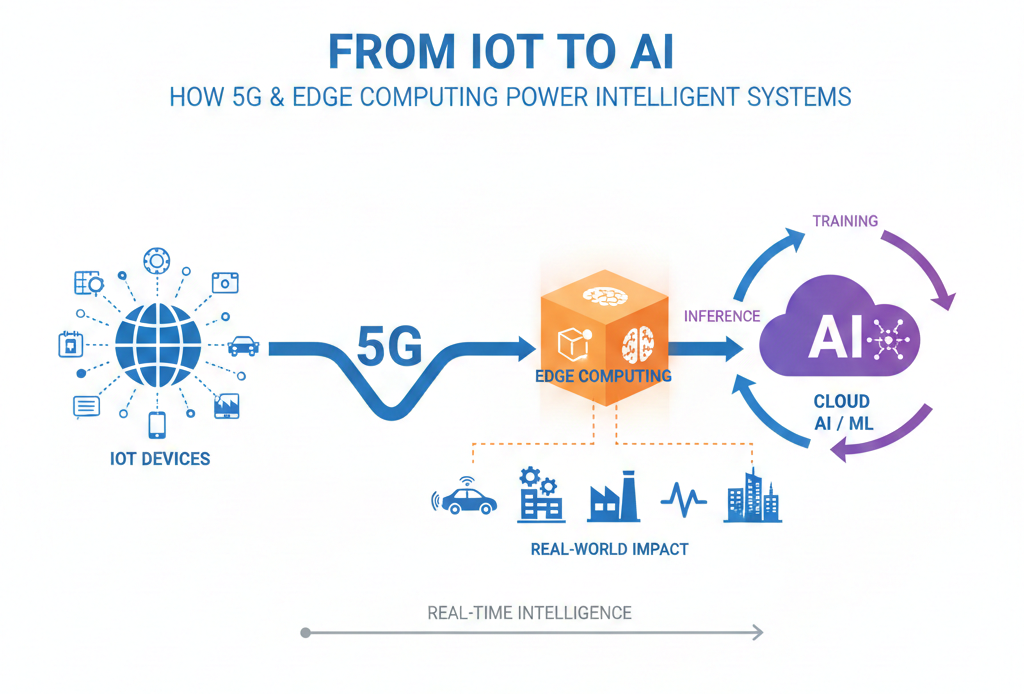
We’re living in an IoT explosion. Over 14 billion connected devices today, racing toward 30+ billion by 2030. These devices generate terabytes of data every hour, but traditional cloud computing can’t keep up.
The problem is physics. Sending data to a distant cloud server and back takes 10-50 milliseconds on 4G networks. For an autonomous car detecting a pedestrian or a surgical robot making an incision, those milliseconds matter. The solution? 5G, edge computing, and AI working together.
Why 5G Changes Everything
5G isn’t just faster internet—it’s purpose-built for intelligent systems with three breakthrough capabilities:
1 millisecond latency enables split-second decisions for autonomous vehicles and remote surgery. Compare that to 4G’s 10-50ms delay.
10 Gbps speeds handle the HD/4K/8K video streams that AI vision systems require to work in real-time.
1 million devices per km² makes truly smart cities possible, where every streetlight, sensor, and camera connects simultaneously.
But the real magic is network slicing—creating dedicated virtual networks for different needs. Your Netflix stream won’t interfere with an autonomous vehicle’s critical safety systems. Each application gets guaranteed performance, no matter what else is happening on the network.
Edge Computing: Bringing the Brain Closer
Here’s the key insight: why send factory camera footage 500 miles to a cloud server when you can analyze it on a local server 50 feet away?
Edge computing deploys servers at 5G base stations, creating a three-tier intelligence system:
- IoT devices collect data
- Edge servers make instant decisions with AI
- Cloud data centers train AI models and handle long-term analytics
Edge AI runs machine learning directly where the action happens. An autonomous vehicle doesn’t upload footage for analysis—it processes object detection locally and receives navigation decisions in under 10 milliseconds.
Real-World Impact
Manufacturing: Siemens Smart Factory uses 5G + edge AI to predict equipment failures before they happen. Robots adjust operations in real-time, eliminating downtime.
Autonomous Vehicles: At 60 mph, a car travels 88 feet per second. A 50ms cloud delay equals 4+ feet of blind travel. Edge AI processes hazard detection in under 10ms, enabling vehicles to coordinate with infrastructure and each other instantly.
Healthcare: Remote surgery requires sub-millisecond latency. Edge AI analyzes medical imaging locally while keeping patient data private. Wearables monitor vitals and generate instant alerts without cloud delays.
Smart Cities: Millions of sensors track traffic, air quality, and energy use. Edge nodes control street lights and traffic signals in real-time, responding to actual conditions instead of fixed schedules.
Supply Chains: Edge AI predicts bottlenecks, optimizes warehouse robots, and reroutes deliveries—all without waiting for cloud processing.
The Technical Formula
When you combine these three technologies, you get something greater than the sum of parts:
5G delivers the connectivity: ultra-fast, ultra-low latency, supporting millions of devices.
Edge Computing provides the location: processing happens near the data source, not in a distant data center.
AI supplies the intelligence: turning raw sensor data into instant, actionable decisions.
Together, they solve the fundamental problem: you can’t make real-time decisions about real-world events if your brain is hundreds of miles away.
What’s Next
The next five years will bring 5G-Advanced networks with AI-optimized traffic management, proliferation of edge AI across industries as costs drop, and billions more IoT devices spanning agriculture to infrastructure monitoring. Non-terrestrial networks will extend 5G coverage via satellites to remote areas.
The architecture is becoming standard: edge handles time-critical inference, cloud trains models and aggregates insights. This hybrid approach gives you both instant response and long-term learning.
The Bottom Line
We’re not just building faster networks or smarter AI. We’re creating a fundamentally new architecture where decisions happen at the speed of reality.
Autonomous factories self-optimize in milliseconds. Vehicles coordinate with split-second precision. Cities adapt to conditions as they change. Healthcare delivers remote care that feels in-person. Supply chains self-correct before problems cascade.
This is the convergence that makes intelligent systems truly intelligent: fast enough to matter, smart enough to decide, and distributed enough to scale. The era of real-time intelligence has arrived.
***
Keywords :
5G edge computing AI, edge AI technology, 5G and edge computing, real time AI systems, IoT edge computing, 5G IoT solutions, intelligent edge networks, edge computing for IoT, AI at the edge, real time data processing, ultra low latency networks, 5G smart systems, next generation connectivity, edge AI applications, distributed AI architecture, real time intelligence systems, autonomous systems technology, smart city edge computing, industrial edge AI, manufacturing edge computing, autonomous vehicle edge AI, healthcare edge computing, remote surgery technology, 5G smart factories, edge computing infrastructure, cloud edge hybrid architecture, edge analytics platform, AI powered edge devices, real time decision systems, 5G network slicing use cases, massive IoT connectivity, low latency AI processing, connected device ecosystem, future of edge computing, 5G advanced networks, intelligent IoT systems, industrial IoT edge AI, smart infrastructure technology, edge computing in supply chain, warehouse automation AI, real time machine learning, distributed computing AI, cyber physical systems, intelligent automation technology, digital transformation edge AI, next generation AI networks, smart industry 4.0 technology, AI driven IoT platforms, real time analytics edge, ultra reliable low latency communication, autonomous factory systems, connected mobility technology, intelligent network architecture.
0 Comments