

Why Custom Workflows are the Heart of Modern Business
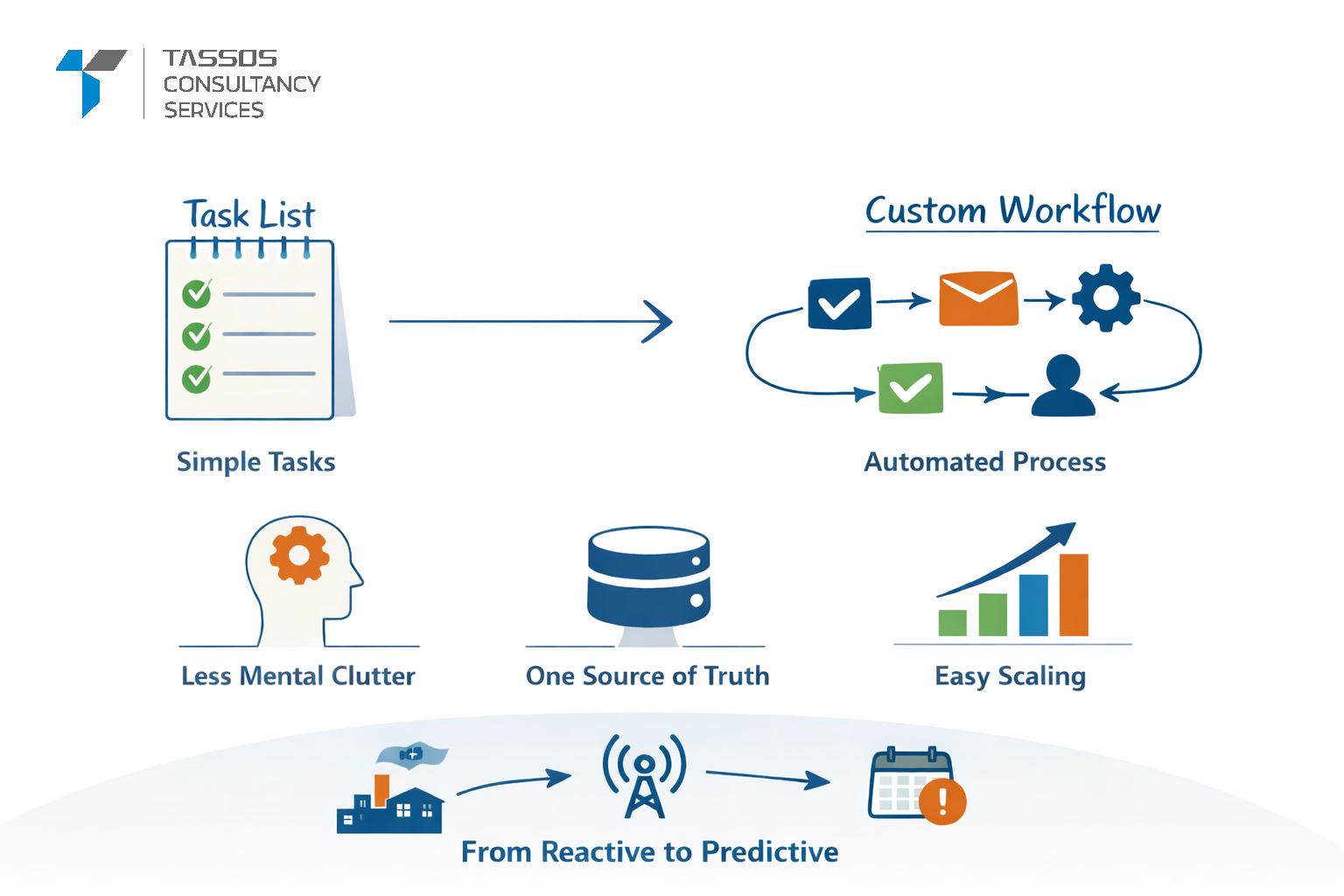
In the early days, a simple to-do list works fine. But as your business grows, things get complicated. More people, more systems, more chances for mistakes. That’s when basic task lists stop helping and start slowing you down.
The solution? Custom workflows. They’re like your business’s circulatory system, moving information to the right place at the right time, automatically.
Tasks vs. Workflows: What’s the Difference?
Task Management answers: “What do I need to do today?”
- Simple checklists
- Relies on people remembering things
- Each task stands alone
Custom Workflows answer: “How does work flow through my business?”
- Connects tasks into automated processes
- Triggers the next step automatically
- Repeatable and trackable
Example: Instead of a manager manually emailing the designer when a brief is approved, the workflow sees the approval, creates the file, notifies the designer, and sets a deadline—all automatically.
Why Generic Software Falls Short
Ready-made tools force your unique business into a generic mold. Your competitive advantage comes from doing things differently. Custom workflows let you build your special process into your system, not the other way around.
Three Key Benefits
1. Less Mental Clutter
Stop wasting time figuring out “who gets this next?” or “where’s the latest file?” Workflows handle the admin work automatically, so your team can focus on real work.
2. One Source of Truth
No more hunting through emails, chats, and documents for information. Everything flows into one central place. Everyone sees the same real-time data.
3. Easy Scaling
Handle 10x the work without 10x the chaos. Smart workflows use AI to spot patterns, predict bottlenecks, and reroute work when teams are overloaded.
Modern Tech Makes It Better
Smart Sensors: A factory sensor detects a problem and automatically orders parts and adjusts schedules—before anyone notices.
5G Speed: Real-time data from anywhere. Drone footage, remote support, instant updates—all feeding into your workflows.
From Reactive to Predictive
Basic processes tell you when something’s wrong. Smart workflows tell you three weeks before a deadline will be missed, so you can fix it early.
The Future Belongs to Flow
The most successful companies don’t just work harder—they work smarter. They’ve stopped managing tasks and started orchestrating workflows. While their competitors are drowning in emails and spreadsheets, they’re running on autopilot, scaling effortlessly, and staying two steps ahead.
The question isn’t whether you need custom workflows. It’s whether you can afford to wait any longer.
Your business deserves a system as unique as your vision. Build it, automate it, and watch it transform chaos into competitive advantage.
Keywords:
Custom business workflows, process automation, digital transformation, operational excellence, workflow optimization, enterprise resource planning, business process management, BPM software, automated workflows, custom software solutions, scalability in business, productivity hacks for teams, task management vs workflow automation, streamlined operations, business efficiency, cloud-based workflows, low-code automation, no-code workflow builders, agile business processes, supply chain automation, CRM customization, ERP integration, data-driven decision making, business logic, organizational growth, technical debt reduction, legacy system modernization, smart business systems, collaborative workflows, remote team management, artificial intelligence in business, machine learning workflows, predictive analytics, real-time data processing, IoT integration, industrial automation, SaaS optimization, custom API integrations, redundant task elimination, bottleneck identification, process mapping, visual workflow editors, cross-functional collaboration, digital workplace, future of work, business agility, competitive advantage, ROI of automation, resource allocation, human-in-the-loop automation, secure data workflows, compliance automation, industry-specific workflows, tailored business logic.

0 Comments