

Manufacturing has changed dramatically over the last decade. What was once driven mainly by machines and manpower is now powered by data, software intelligence, and real-time decision systems. In modern factories, the ERP system is no longer just an accounting or inventory tool — it has become the digital brain that governs production planning, procurement, quality, costing, maintenance, and compliance.
As cloud software became popular, many manufacturers were encouraged to move their entire ERP infrastructure to the cloud. Cloud platforms promised faster deployment, lower upfront cost, easy scalability, and access from anywhere. For office-centric businesses, this shift made sense. But manufacturing is not an office business. It is a time-critical, machine-integrated, always-running operation — and cloud-only ERP models introduce risks that most factories only realize after experiencing downtime, delays, or data control challenges.
Manufacturing Runs on Continuity, Not Convenience
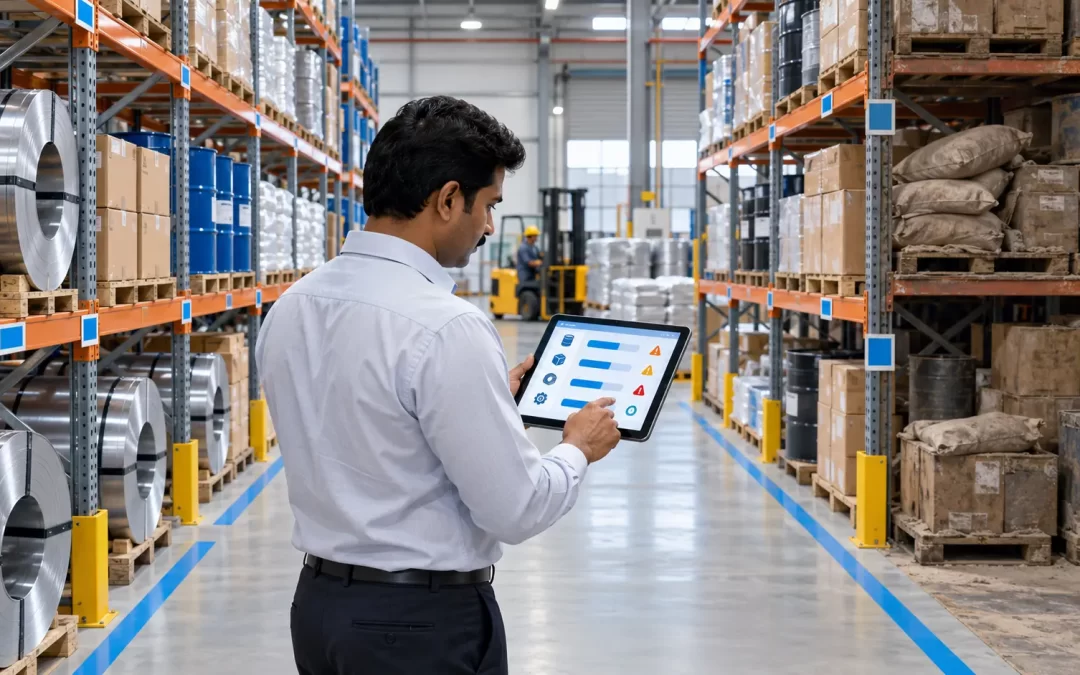
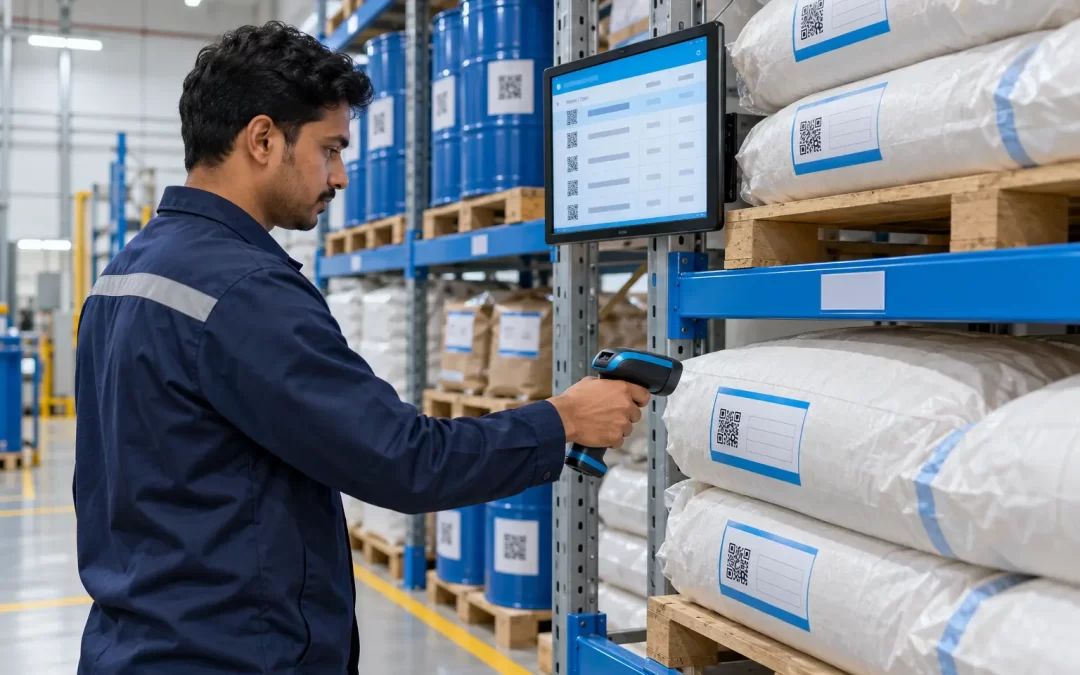
A factory floor does not stop because the internet slows down. Machines continue to run, operators continue to work, and production schedules remain tight regardless of network stability. Manufacturing environments depend on continuous access to production orders, routing instructions, quality checks, maintenance schedules, barcode scanning, and machine data — all of which rely on ERP availability.
Cloud-only ERP systems depend entirely on stable, high-speed internet connectivity. Even a short network outage can freeze work orders, prevent material issuance, stop barcode transactions, and disrupt machine reporting. In high-volume or process manufacturing, minutes of downtime can translate into thousands or even lakhs of rupees in losses. When the ERP system becomes unreachable, production intelligence collapses, and operations are forced into manual workarounds that increase error rates and compliance risks.
This makes internet dependency a direct production risk — not just an IT inconvenience.
Latency and Real-Time Control Limitations
Modern manufacturing increasingly uses real-time decision systems. Production scheduling adjustments, sensor-based monitoring, barcode validations, quality checks, and shop-floor data capture require near-instant responses. Cloud platforms, by design, introduce network latency — even if minimal — which can accumulate across thousands of transactions every day.
On busy shop floors, even small delays can lead to production slowdowns, queue buildup, and operator frustration. Machine-level integrations such as PLCs, SCADA systems, and IoT sensors also demand local, low-latency data processing. Cloud-only ERP systems struggle to maintain this level of responsiveness consistently, especially in geographically remote or industrial zones with unstable connectivity.
Manufacturers don’t just need data — they need it instantly, reliably, and locally.
Data Ownership and Compliance Are Becoming Strategic Concerns
Manufacturing ERP systems store highly sensitive and valuable intellectual property — including BOM structures, product recipes, costing formulas, supplier contracts, and customer data. In cloud-only environments, this information often resides in data centers located in other countries and under foreign legal jurisdictions.
With rising data protection laws, audit requirements, and increasing cyber threats, manufacturers are becoming more cautious about where their data lives and who ultimately controls it. Losing sovereignty over production data can expose companies to compliance penalties, intellectual property risks, and vendor dependency that becomes difficult to reverse over time.
Data is no longer just an asset — it is a strategic advantage. Losing control over it weakens long-term competitiveness.
What Is Hybrid ERP?
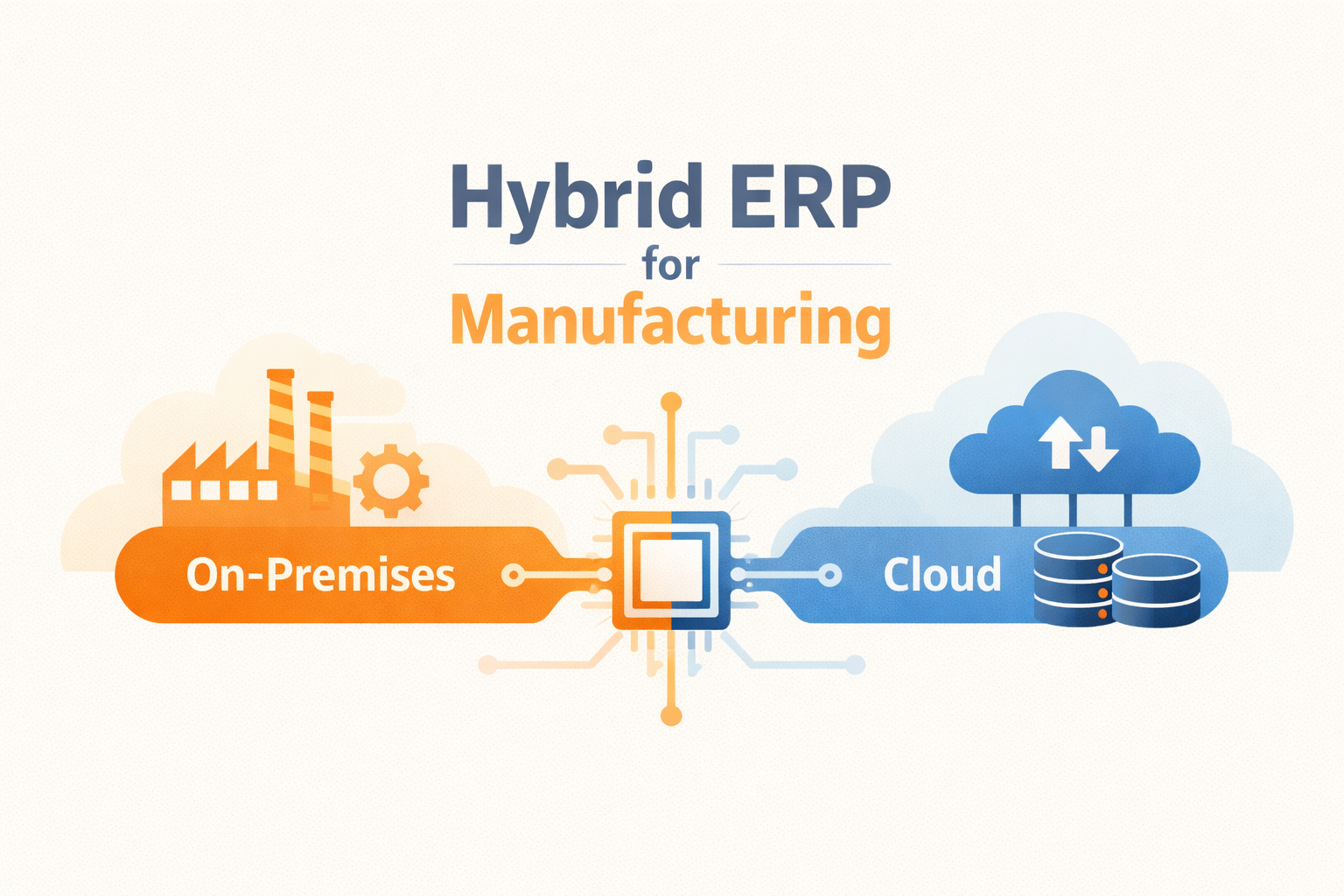
Hybrid ERP combines the strengths of both on-premise and cloud architectures. Core manufacturing operations — such as production, inventory, quality, maintenance, and machine integrations — remain hosted locally on factory infrastructure. At the same time, cloud services are used for analytics, reporting, mobile access, collaboration, and centralized management.
In simple terms, hybrid ERP ensures that the factory continues to run locally at full speed while the cloud adds intelligence, scalability, and visibility — without introducing operational dependency.
Why Hybrid ERP Is the Natural Evolution of Manufacturing Systems
Hybrid ERP restores real-time control to factory floors. Since core systems are hosted locally, operations remain uninterrupted even during internet outages. Production, barcode scanning, machine integrations, and maintenance workflows continue to function seamlessly.
Local hosting also enables faster execution. Machine data, IoT streams, and shop-floor transactions are processed instantly without cloud latency, improving production flow, accuracy, and throughput.
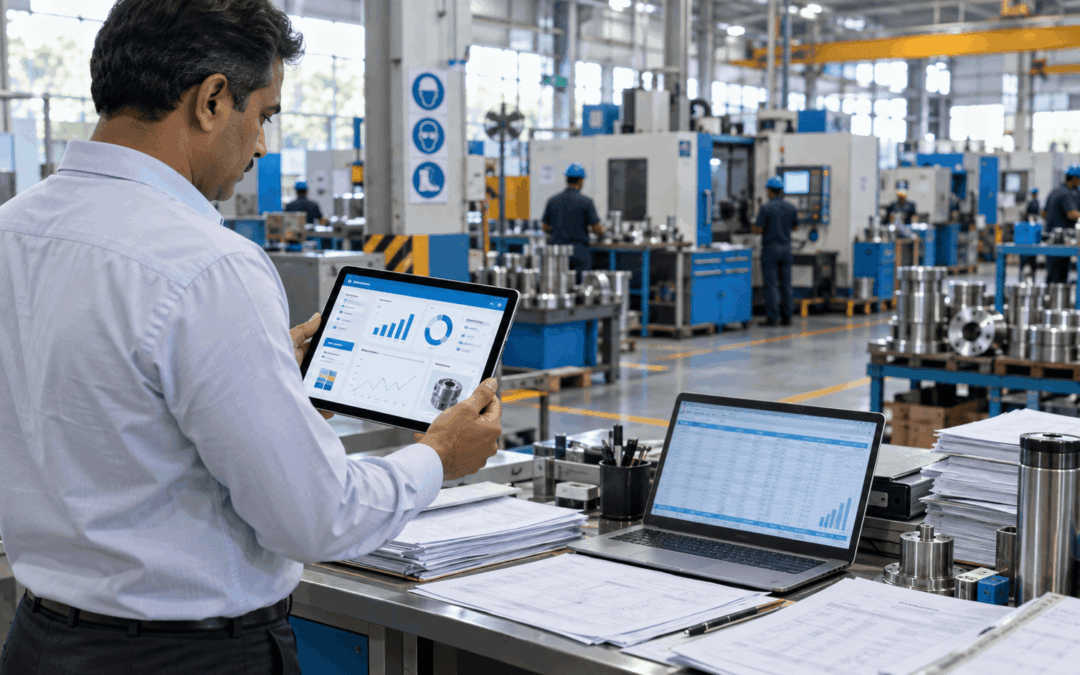
At the same time, cloud services provide strategic advantages. Management teams gain centralized dashboards, mobile access, predictive analytics, and remote monitoring without putting operational continuity at risk. Manufacturers get the best of both worlds — speed and control locally, intelligence and visibility globally.
From a financial perspective, hybrid ERP also reduces long-term dependency on escalating subscription pricing models. Businesses retain ownership of their core systems while selectively leveraging cloud services for growth and expansion.
The Future Factory Needs Hybrid Architecture
As factories adopt Industry 4.0 technologies such as predictive maintenance, AI-driven forecasting, digital twins, and smart inventory systems, the need for hybrid architecture becomes even stronger. These systems require both high-speed local processing and powerful cloud-based analytics — something cloud-only or on-prem-only models cannot deliver alone.
Hybrid ERP becomes the digital backbone that connects machines, people, data, and intelligence into a resilient, scalable, and future-ready manufacturing ecosystem.
***
Keywords :
hybrid ERP for manufacturing, manufacturing ERP systems, hybrid cloud ERP, on premise ERP manufacturing, cloud ERP manufacturing, factory ERP solutions, manufacturing digital transformation, smart manufacturing ERP, industry 4.0 ERP systems, manufacturing execution ERP, shop floor ERP integration, real time manufacturing systems, manufacturing data management, ERP for production planning, manufacturing operations ERP, hybrid manufacturing architecture, ERP for factory automation, machine integrated ERP, manufacturing ERP software, industrial ERP solutions, resilient manufacturing systems, manufacturing business continuity ERP, low latency manufacturing ERP, manufacturing cloud strategy, ERP for smart factories, hybrid IT manufacturing, manufacturing information systems, manufacturing ERP modernization, digital factory ERP, industrial cloud ERP, manufacturing ERP platform, factory management software, production ERP solutions, manufacturing intelligence systems, ERP for industrial IoT, smart factory software, manufacturing analytics ERP, hybrid enterprise systems, manufacturing technology trends, future of manufacturing ERP, manufacturing systems architecture, ERP for operational continuity, manufacturing software infrastructure, ERP for plant operations, manufacturing digital backbone, intelligent manufacturing systems, hybrid systems industry 4.0, manufacturing automation ERP, ERP for quality management manufacturing, ERP for inventory and production, next generation manufacturing ERP, industrial digital transformation, manufacturing ERP strategy.
0 Comments